


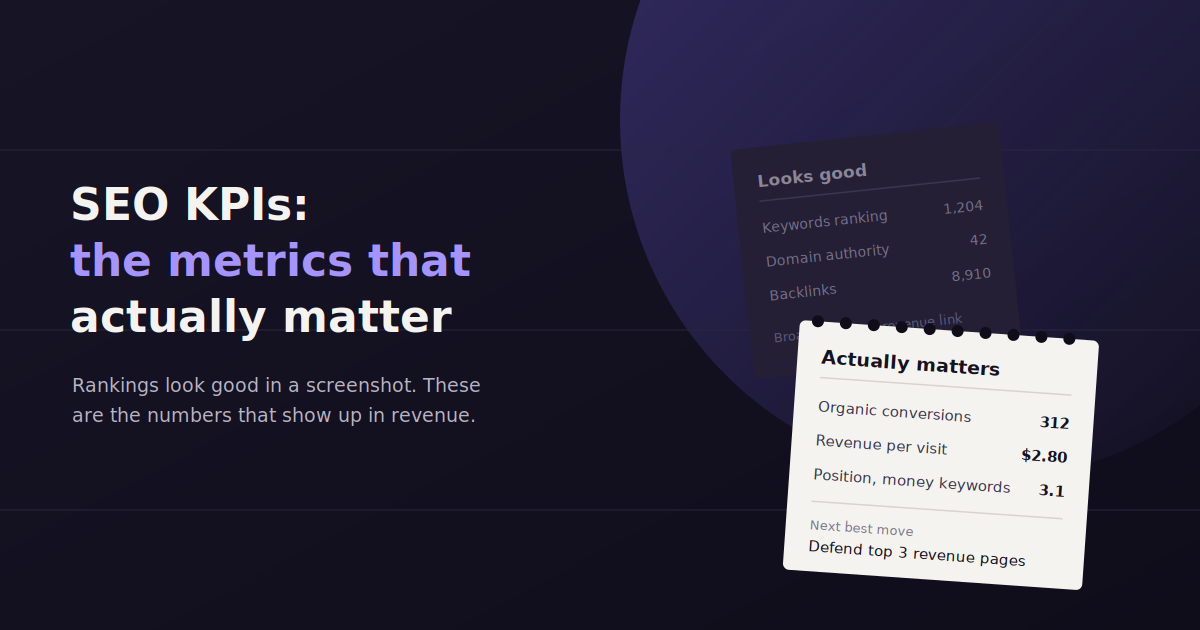
Rankings moving up is a nice thing to see in a report. It’s also, on its own, not proof that SEO is working.
SEO KPIs worth tracking go beyond position tracking into traffic quality, click behavior, technical health, and — most importantly — whether any of it converts into something a business cares about.
This guide covers the KPIs that actually explain SEO performance, how they connect to each other, realistic benchmarks, and the mistakes that make an SEO report look better or worse than the reality underneath it.
None of this requires exotic tooling. Google Search Console and Google Analytics cover most of it for free; the rest comes from a dedicated SEO platform or rank tracker.
Why SEO Needs Its Own Set of KPIs
SEO is slower and less directly attributable than paid channels, which makes it tempting to fall back on whatever metric is easiest to pull — usually rankings or raw traffic. Both are useful, but neither answers the question a business actually cares about on its own.
A good set of SEO KPIs covers four layers: visibility (are you showing up), engagement (does the traffic behave like it’s finding what it wants), technical health (is the site capable of ranking well), and outcomes (does any of this turn into revenue or leads).
Skipping straight to outcomes without the layers underneath makes it hard to diagnose why something changed. Skipping outcomes entirely and reporting only visibility metrics makes it hard to prove SEO is worth the investment in the first place.
Visibility KPIs: Are You Showing Up?
Visibility KPIs — organic traffic, keyword rankings, and impressions — measure whether a site is appearing in search results at all, forming the foundation everything else in an SEO report builds on.
These are usually the first metrics anyone checks, and they’re the right starting point, as long as they don’t become the whole story.
Organic Traffic
Organic traffic counts sessions arriving from unpaid search results, tracked in Google Analytics or a similar platform. It’s the broadest signal of SEO health and the easiest one to trend over time.
The catch is that organic traffic alone says nothing about whether that traffic is useful. A spike driven by an unrelated viral keyword or a low-intent query can inflate the number without moving any business metric that actually matters.
Segmenting organic traffic by branded versus non-branded search helps here — branded traffic reflects existing brand awareness more than SEO effort, while non-branded growth is the cleaner signal of SEO actually earning new visibility.
Keyword Rankings
Tracking position for target keywords over time remains one of the more direct ways to see whether specific optimization work is having an effect, typically pulled from a rank tracker like Semrush rather than Search Console alone.
Rank tracking works best in aggregate rather than obsessing over single-keyword movement — a page can drop three positions on its primary keyword while gaining on ten secondary ones, and the net effect on traffic can still be positive.
Personalized and localized search results also mean an individual’s own search position isn’t a reliable check — always confirm ranking data through a dedicated tool rather than a manual search.
Impressions
Impressions, available directly in Google Search Console, count how often a page’s link appeared in search results, regardless of whether anyone clicked.
Rising impressions with flat clicks is a useful diagnostic signal on its own — it usually means rankings are improving for queries where the page isn’t winning the click, which points toward a title tag or meta description problem rather than a ranking problem.
Engagement and Click Behavior KPIs
Click-through rate and on-page engagement metrics reveal whether visibility is translating into actual interest — a page ranking well but earning few clicks or quick exits usually has a relevance or presentation problem, not a rankings problem.
This layer connects visibility to actual human behavior, and it’s where a lot of SEO problems that look like ranking issues actually reveal themselves as something else.
Click-Through Rate (CTR)
CTR measures the percentage of impressions that result in a click, tracked by query and by page inside Search Console. It’s directly influenced by title tags, meta descriptions, and how well a result matches what someone actually searched for.
CTR expectations vary heavily by position and query type — a page in position one commands a much higher CTR than one in position eight, and a branded query converts to a click far more reliably than a broad informational one.
A page ranking well but underperforming on CTR relative to its position is often fixable without touching rankings at all — a sharper title tag or a more compelling meta description alone can move the number meaningfully.
Bounce Rate and Engagement Rate
Whether measured as the old bounce rate or GA4’s engagement rate, this metric shows whether organic visitors found what they expected once they arrived. High traffic paired with poor engagement usually points to a mismatch between what a page ranks for and what it actually delivers.
Context matters more here than almost anywhere else in SEO reporting — a high exit rate on a page answering a single quick question isn’t the same problem as one on a product page that’s supposed to drive a purchase.
Pages per Session and Time on Page
These secondary engagement signals help distinguish a quick, satisfied visit from a confused one, though neither should be read in isolation from the page’s actual purpose.
A support article answered in 40 seconds and one page view isn’t underperforming — it did its job. The same numbers on a long-form guide meant to build trust before a purchase decision would be a different story.
Technical Health KPIs
Core Web Vitals, crawl health, and indexation status measure whether a site is technically capable of ranking and being properly evaluated by search engines — issues here silently cap performance everywhere else.
Technical KPIs rarely get the same attention as rankings or traffic, but a technical problem can quietly suppress every other number on this list without anyone realizing why performance has stalled.
Core Web Vitals
Core Web Vitals measure real-world page experience across three dimensions: Largest Contentful Paint (loading speed), Interaction to Next Paint (responsiveness), and Cumulative Layout Shift (visual stability).
These are confirmed ranking factors, and they’re also directly tied to user experience and conversion rate independent of SEO — a slow, jumpy page loses visitors regardless of how well it ranks to begin with.
Search Console’s Core Web Vitals report groups URLs into good, needs improvement, and poor buckets, which is usually a faster way to prioritize fixes than chasing a single site-wide average score.
Indexation and Crawl Stats
The ratio of indexed to submitted pages, tracked in Search Console’s coverage report, shows whether search engines can actually find and process a site’s content in the first place.
A sudden drop in indexed pages is one of the more urgent technical signals to catch early — it often traces back to a robots.txt change, an accidental noindex tag, or a crawl budget issue on a larger site.
Outcome KPIs: Does It Convert?
This is the layer that ultimately justifies the SEO investment, and it’s the one most likely to get skipped in favor of the easier upstream metrics.
Organic conversion rate — the percentage of organic sessions completing a meaningful action — connects directly to revenue or lead generation, and it’s the number that should anchor any conversation about SEO ROI.
Backlinks and referring domains sit in this section too, even though they feel closer to visibility, because their real value is downstream: quality backlinks influence ranking authority, which influences visibility, which eventually influences conversions. New and lost backlinks, tracked over time, show whether that authority is growing or eroding.
SEO KPI Benchmarks
General benchmark ranges for common SEO KPIs, useful as a starting sanity check rather than a strict target, since actual healthy ranges vary significantly by industry and site type.
| KPI | Typical Range | Where to Check It |
|---|---|---|
| Organic CTR (position 1–3) | 15%–30%+ | Search Console |
| Organic conversion rate | 1%–5% | Google Analytics |
| Core Web Vitals (good URLs) | 75%+ of URLs | Search Console |
| Index coverage | 90%+ of submitted pages | Search Console |
| Branded vs. non-branded split | Varies by brand maturity | Search Console (filtered by query) |
| Domain-level referring domains growth | Steady month-over-month gain | Rank tracking / backlink tool |
Building an SEO KPI Report That Shows the Full Picture
A useful SEO report doesn’t lead with rankings and stop there. It moves through the funnel — visibility, engagement, technical health, outcomes — so a reader can see not just what changed, but where in the chain it changed.
Pulling this together usually means combining Search Console, Google Analytics, and a rank tracker or backlink tool, since no single free tool covers all four layers on its own.
This is a natural fit for a conversational reporting approach. A tool like ConvoData connects to Search Console, GA4, and other marketing data sources, so a question like “which pages lost organic traffic this month and why” gets answered directly with live data and a suggested next step, instead of requiring someone to cross-reference three separate reports by hand.
Common Mistakes When Tracking SEO KPIs
A handful of habits repeatedly undermine otherwise solid SEO reporting.
Reporting rankings without traffic or conversion context. A keyword hitting position one on a query nobody searches for isn’t a meaningful win.
Ignoring branded traffic skew. A site with strong brand recognition can show healthy organic traffic numbers that have little to do with actual SEO work.
Treating Core Web Vitals as a one-time fix. Site updates, new plugins, and added scripts can quietly regress page speed after an initial fix, so it needs periodic rechecking, not a single pass.
Confusing correlation with causation on ranking changes. Algorithm updates, seasonality, and competitor changes all move rankings independent of anything a site did.
Not segmenting conversion rate by query intent. Blending informational and transactional query traffic into one conversion rate number understates how well the site converts its actual buying-intent traffic.
Once you have settled on which KPIs matter, our complete guide to SEO analytics covers how to actually measure and act on them. If ranking is one of your core KPIs, pair it with a proper keyword rank monitoring setup, and use our SEO roadmap guide to turn the metrics into a prioritized plan.
Frequently Asked Questions
What are the most important SEO KPIs to track?
Organic traffic, keyword rankings, click-through rate, Core Web Vitals, backlinks, and organic conversion rate cover the core layers of SEO performance — visibility, engagement, technical health, and outcomes.
Is organic traffic alone a good measure of SEO success?
No. Organic traffic shows visibility but says nothing about quality or business impact on its own. Pairing it with organic conversion rate and engagement metrics gives a much more complete picture of whether SEO is actually working.
What are Core Web Vitals and why do they matter for SEO?
Core Web Vitals measure page loading speed, interaction responsiveness, and visual stability. They're a confirmed Google ranking factor and are also tied directly to user experience and conversion rate, independent of SEO.
How do I track SEO KPIs without paying for expensive software?
Google Search Console and Google Analytics are free and cover organic traffic, impressions, CTR, engagement, conversions, and Core Web Vitals. Keyword rank tracking and backlink monitoring typically require a dedicated paid tool.
What's a good organic conversion rate?
It typically falls between 1% and 5%, though this varies significantly by industry, site type, and query intent. Comparing a site's own trend over time is generally more useful than comparing against a broad external benchmark.
How often should SEO KPIs be reported?
Monthly is standard, since SEO changes tend to show measurable movement over weeks rather than days. Technical issues like a Core Web Vitals regression or a drop in indexed pages are worth checking more frequently, since they can compound the longer they go unnoticed.
Want your SEO KPIs answering questions instead of sitting across three separate tools? Connect Search Console and GA4 to ConvoData and ask your first SEO question — plans start at $39/month.