


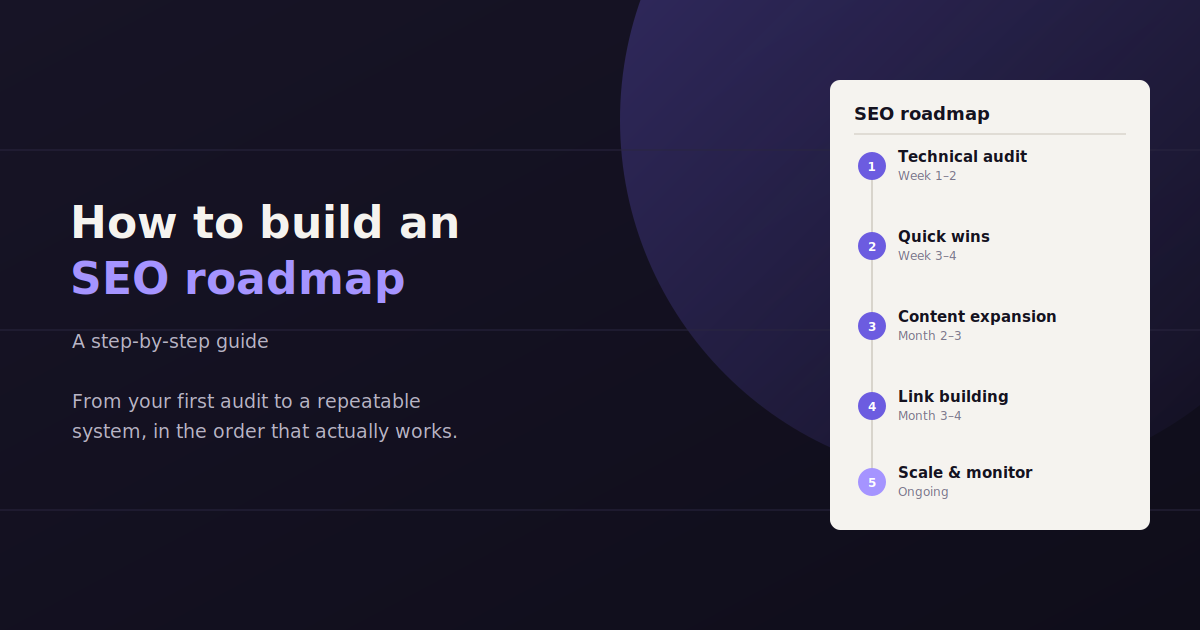
SEO fails most often not from bad tactics but from no sequence — teams chase whatever ranking issue surfaced last week instead of working through a prioritized plan.
An SEO roadmap fixes that by turning a pile of audit findings and keyword opportunities into a dated, owned, trackable plan that survives beyond one person’s memory.
This guide walks through what a roadmap actually needs to contain, how to build one from scratch, and how to keep it from going stale three months after you finish it.
What Is an SEO Roadmap?
An SEO roadmap is a prioritized, time-bound plan that connects SEO goals to specific deliverables, owners, and deadlines — turning audit findings and keyword research into a sequence of work instead of a static report nobody revisits.
An SEO roadmap is a working document, not a report. It lists what you’re trying to achieve, what work gets you there, who owns each piece, and by when.
It differs from an SEO strategy in scope: a strategy sets direction (“grow organic revenue from non-branded search”), while a roadmap breaks that direction into scheduled, assignable tasks.
Most roadmaps run on a quarterly or monthly cadence, with a rolling three- to six-month view so priorities can shift as rankings, algorithm updates, or business goals change.
Why Teams Fall Behind Without One
Without a roadmap, SEO work tends to follow whoever complained loudest that week — a client asking about one keyword, a stakeholder noticing one competitor’s ranking. Priority becomes reactive instead of strategic.
It also creates an accountability gap. When “someone should fix the site’s Core Web Vitals” isn’t attached to a name and a date, it rarely gets fixed.
A roadmap solves both problems at once: it forces prioritization before work starts, and it makes ownership visible to everyone who can see the document.
The Five Questions Every SEO Roadmap Should Answer
What — which specific SEO initiatives are planned (technical fixes, content gaps, link building, etc.)?
Why — what business or ranking outcome does each initiative support?
When — what’s the target completion date, and how does it sequence against other work?
Who — which person or team owns delivery, and who needs to approve it?
How will we know — what metric proves the initiative worked?
Core Components of an SEO Roadmap
A complete SEO roadmap includes prioritized goals tied to business outcomes, a prioritized backlog of initiatives scored by impact and effort, clear ownership per item, target dates, and the KPI each initiative is meant to move.
1. Goals Tied to Business Outcomes
Start with goals stated in business terms, not SEO jargon — “increase qualified organic leads 20% by Q3” beats “improve keyword rankings.”
This framing matters later: it’s what lets you defend a roadmap item’s priority to a stakeholder who doesn’t care about SEO mechanics, only outcomes.
2. A Prioritized Backlog
Pull every candidate initiative — from a technical audit, keyword gap analysis, competitor research, or backlog carried over from last quarter — into one list before you prioritize anything.
Score each item on impact and effort, then sequence high-impact, low-effort work first. This single step prevents the common trap of starting with whatever’s most interesting rather than what matters most.
3. Ownership and Accountability
Every line item needs exactly one owner — a person, not a team — even if multiple people contribute to the work.
Shared ownership is functionally no ownership; when three people are responsible, none of them treats the deadline as theirs.
4. Dates and Sequencing
Attach a target date to every item, even a rough one. An undated task quietly slides to the bottom of every priority list forever.
Sequence dependent work correctly — technical fixes that affect crawlability generally need to land before a content push, since new content won’t rank well on a site Google can’t crawl efficiently.
5. KPIs Per Initiative
Attach a specific, measurable KPI to each initiative — organic sessions, keyword position, conversion rate from organic traffic — not just to the roadmap as a whole.
This makes it possible to retire or double down on individual initiatives based on evidence, rather than judging the whole roadmap as one undifferentiated success or failure.
How to Build an SEO Roadmap: Step by Step
The process below works whether you’re building a roadmap for an in-house team or a client account, and takes most teams a half-day to a full day for the first draft.
Step 1 — Audit current state. Run a technical audit, review current rankings and traffic, and note any glaring gaps before you plan anything new.
Step 2 — Set 2–4 measurable goals. Keep the list short. A roadmap trying to hit ten goals at once accomplishes none of them well.
Step 3 — Build the initiative backlog. Combine audit findings, keyword opportunities, content gaps, and any carried-over work into one list.
Step 4 — Score and prioritize. Rank each item by expected impact against required effort, and sequence dependencies correctly.
Step 5 — Assign owners and dates. Every item needs one accountable person and a target date before the roadmap is considered final.
Step 6 — Review monthly. Revisit the roadmap on a fixed schedule — monthly works for most teams — and adjust for what actually happened, not what was planned.
A Simple SEO Roadmap Template
You don’t need special software to start — a shared spreadsheet with the columns below covers the essentials for most teams.
| Initiative | Goal Supported | Owner | Target Date | KPI |
|---|---|---|---|---|
| Fix crawl errors on 40 product pages | Increase organic sessions 20% | Dev lead | Week 2 | Indexed page count |
| Publish 6 comparison pages | Grow non-branded search traffic | Content lead | Week 6 | Organic sessions to new pages |
| Build 10 links to core category pages | Improve keyword rankings top 10 | SEO specialist | Week 8 | Referring domains, avg. position |
| Improve Core Web Vitals on mobile | Reduce bounce rate on landing pages | Dev lead | Week 4 | LCP, CLS scores |
Impact vs. Effort Scoring: A Practical Framework
Most roadmaps stall at the prioritization step because “impact” and “effort” stay vague. Scoring both on a simple numeric scale turns an argument about opinions into a ranked list almost everyone agrees with.
A workable version uses a 1-5 scale for both dimensions. Impact asks: if this works, how much does it move the goal metric — organic sessions, qualified leads, revenue? Effort asks: how many hours or how many people does this actually take, including review and QA, not just the work itself.
Divide impact by effort and the highest-scoring items rise to the top automatically. A technical fix scored 4 impact / 1 effort (fix a broken redirect chain) should almost always outrank a content initiative scored 3 impact / 5 effort (a 20-page content cluster), even though the content project feels more substantial.
The scoring doesn’t need to be scientific to be useful — the point is forcing every initiative through the same two questions instead of prioritizing by whoever pitched it most persuasively in a planning meeting. Revisit the scores at each monthly review, since effort estimates in particular tend to be wrong the first time and get more accurate with a cycle of real data behind them.
SEO Roadmap Examples by Business Type
The framework stays the same across business types — goals, backlog, ownership, dates, KPIs — but the first quarter’s priorities and the KPI that matters most shift with the business model. A local service business chasing organic revenue as its primary KPI is measuring the wrong thing; calls and direction requests are what the SEO work actually influences most directly.
Agencies managing multiple client types benefit from keeping a standard roadmap template but customizing the KPI column per client from the start, rather than retrofitting reporting to match generic metrics after the fact.
| Business Type | Typical First-Quarter Priority | Primary KPI |
|---|---|---|
| Local service business | Google Business Profile optimization, local pack rankings | Calls, direction requests, local pack position |
| Ecommerce | Product page technical fixes, category page content | Organic revenue, ROAS from organic, page-level conversion rate |
| SaaS / B2B | Bottom-funnel comparison and use-case content | Marketing qualified leads from organic, non-branded demo requests |
| Publisher / content site | Content freshness, internal linking, Core Web Vitals | Organic sessions, pages per session, ad revenue per session |
Keeping a Roadmap From Going Stale
Most SEO roadmaps die the same way: they’re built with real effort once, then never opened again after month one.
A fixed monthly review — even 30 minutes — is the single habit that keeps a roadmap alive. Update statuses, re-score anything that’s shifted in priority, and add new items as they surface.
Some teams now use conversational AI reporting tools to pull the performance data that feeds this review automatically. ConvoData, for example, lets you ask a plain-English question like “which pages on the roadmap actually gained rankings this month” and get a live answer from your connected data, rather than manually rebuilding that check from scratch every review cycle.
That doesn’t replace the roadmap document itself — it just removes the manual data-pulling step that usually causes reviews to get skipped in the first place.
Common SEO Roadmap Mistakes
Too many goals at once — a roadmap with ten priorities has no priorities.
No owner per item — shared responsibility means nobody is actually accountable.
Ignoring dependencies — sequencing content work ahead of a technical fix that blocks indexing wastes the content effort.
Building it once and never revisiting it — a roadmap not reviewed monthly becomes a historical document, not a working plan.
Confusing activity with outcome — “publish 10 blog posts” isn’t a goal; “grow organic leads 20%” is, and the blog posts are one initiative that might support it.
A roadmap is only as good as the metrics you are using to prioritize it. Our guide to the SEO KPIs that actually matter covers which numbers should shape your priorities, and once ranking work is underway, see how to track SEO ranking so you know whether the roadmap is working. If you do not already have a central view of your organic performance, our guide to building an SEO dashboard with GA4, GSC, and Ahrefs is a good next step.
Frequently Asked Questions
What is the difference between an SEO roadmap and an SEO strategy?
A strategy sets overall direction and goals; a roadmap breaks that direction into specific, dated, owned initiatives that can actually be tracked and executed week to week.
How often should an SEO roadmap be updated?
Monthly works for most teams — frequent enough to stay accurate, infrequent enough that the review doesn't become a burden that gets skipped.
How far out should an SEO roadmap plan?
Three to six months is typical for a rolling roadmap; beyond that, priorities usually shift enough that detailed planning stops being useful.
Who should own an SEO roadmap in an agency setting?
Usually the account lead or SEO strategist owns the roadmap document itself, while individual initiatives are assigned to whoever actually executes the work — a developer, content writer, or link-building specialist.
Can I build an SEO roadmap without special software?
Yes — a shared spreadsheet or project management board with columns for initiative, goal, owner, date, and KPI covers the core structure most teams need.
How do I prioritize initiatives on an SEO roadmap?
Score each candidate initiative on expected impact versus required effort, sequence anything with technical dependencies first, and limit the active list to what your team can realistically execute in the current cycle.
What's the difference between an SEO roadmap and a content calendar?
A content calendar schedules specific pieces of content — what publishes and when. An SEO roadmap is broader, covering technical fixes, link building, and structural work alongside content, all tied back to measurable goals. A content calendar is usually one input into a roadmap, not a replacement for it.
Should an SEO roadmap include competitor analysis?
Yes, typically as an input to the backlog rather than a standing section — a competitor gap analysis often surfaces initiatives (a content topic they rank for and you don't, a technical advantage they have) that get scored and sequenced into the roadmap alongside everything else, rather than tracked as a separate ongoing project.
Pull your last technical audit and keyword research into one list, score each item by impact and effort, and you already have the start of a roadmap. When it’s time to track whether those initiatives actually moved the numbers, ask ConvoData directly instead of rebuilding the check by hand every month — plans start at $39/month.