


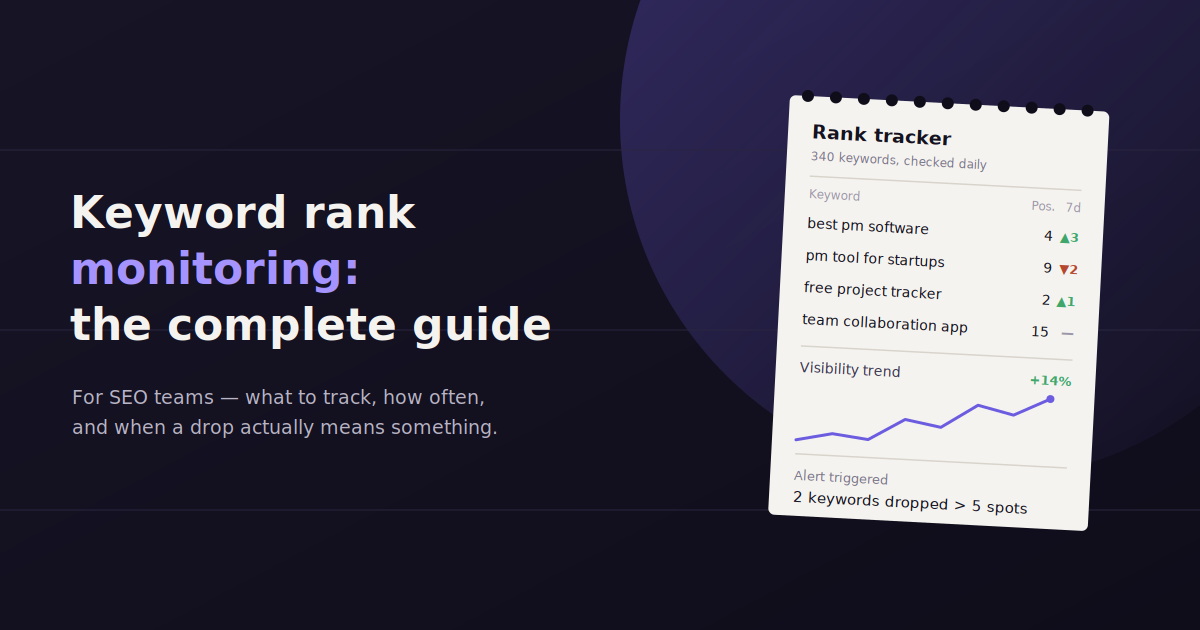
A keyword can hold position three for months and then slide to page two overnight without anyone noticing until traffic has already dropped.
Keyword rank monitoring is the practice of tracking where your pages sit in search results over time, so a slide like that gets caught in days, not at the end of a quarterly review.
Done well, it turns SEO from a once-a-month guessing game into an ongoing feedback loop: you make a change, you watch how rankings respond, and you adjust before a client or a boss asks what happened.
This guide covers what keyword monitoring actually is, how the tracking technology works under the hood, what to watch beyond raw position, and how to build a workflow that fits a small team without turning into a full-time job.
What Is Keyword Rank Monitoring?
Keyword rank monitoring is the ongoing process of checking where a set of target keywords rank in search engine results, on a recurring schedule, and logging that data so you can see how it changes over time.
It’s different from a one-off rank check, which tells you where you stand today but nothing about the trend. A single snapshot can’t tell you whether a page is climbing, sliding, or holding steady, and it can’t warn you before a drop becomes a traffic problem.
Most teams track a mix of keyword types: branded terms, high-intent commercial keywords, informational queries that feed the top of the funnel, and a handful of competitor terms worth watching for context.
The output is usually a rank history per keyword, per page, per device, and sometimes per location, since the same query can return very different results depending on where and how someone searches.
Why Keyword Monitoring Matters for SEO and Marketing Teams
Search results are not static. Google runs core algorithm updates several times a year, competitors publish new content, and SERP layouts shift to add or remove features like featured snippets and video carousels. Any one of those can move your rankings without you touching a single page.
Without monitoring, the first sign of a ranking drop is usually a traffic dip that someone notices weeks later in an analytics review, by which point the cause is harder to trace and the lost traffic has already compounded.
For agencies, monitoring is also the evidence behind client conversations. A ranking history that shows steady upward movement, or a clear correlation between a content update and a jump in position, is a far stronger argument than a description of the work done.
For in-house teams, monitoring closes the loop on strategy decisions. If you rewrote twenty product pages last quarter, tracking tells you whether that effort actually moved rankings or whether the budget would have been better spent elsewhere.
Catches drops early so you can diagnose the cause (a core update, a lost backlink, a competitor’s new page) while it’s still fresh and fixable.
Validates SEO work by connecting specific changes, like a title rewrite or an internal linking pass, to measurable movement in position.
Surfaces opportunity when a keyword sits just outside the top results, since a page ranking eleventh often needs a much smaller push than one ranking fortieth.
Gives client reporting a spine by replacing vague progress updates with an actual, dated record of where rankings stood and how they moved.
How Keyword Rank Tracking Actually Works
Rank trackers query search engines the way a real searcher would, from a specific location and device, then parse the results page to find your listed URL and record its position, along with any SERP features shown alongside it.
It’s worth understanding the mechanics, because they explain both the value and the limits of any rank tracker you use.
Crawlers and SERP Scraping
A rank tracking tool doesn’t have privileged access to Google’s index. Instead, it runs automated searches for each tracked keyword, from a chosen location and device type, and then parses the resulting page to find where your domain appears.
This process is technically similar to what a scraper does on any website, which is why search engines actively try to detect and block automated querying. Reliable tracking tools manage this with rotating IP addresses, proxy networks, and request pacing designed to look enough like normal search behavior to avoid getting blocked or rate-limited.
Because the tool is simulating a search rather than reading a database, results can occasionally vary slightly between two checks run minutes apart, the same way two people searching from different networks might see marginally different results. That’s normal and not a sign the tool is broken.
Tracking Frequency and Data Freshness
Most tools offer a choice of daily, weekly, or on-demand checks per keyword. Daily tracking uses more of your tool’s query budget but catches volatility that a weekly check would smooth over entirely.
There’s a real cost tradeoff here beyond price. Checking too frequently on low-priority, low-volume keywords burns budget you could spend tracking more terms or more locations. Checking too infrequently on your highest-value keywords means you can go a week or two without noticing a problem.
A sensible default is to track your top revenue-driving keywords daily, your broader keyword set weekly, and anything purely exploratory on a monthly or on-demand basis.
What to Track Beyond Raw Rank Position
Raw position alone misses most of the story. SERP feature presence, ranking volatility, and the local-versus-national split all shape how much a rank change actually matters to your traffic.
Two keywords can both hold position four and mean completely different things for your traffic, depending on what else appears on that results page and how stable that position has historically been.
SERP Features
Featured snippets, People Also Ask boxes, local map packs, video carousels, and shopping results all push organic listings further down the page, sometimes below the fold even at position one.
Tracking whether a SERP feature is present for a given keyword, and whether you own it, matters as much as tracking the position number itself. Losing a featured snippet to a competitor can cut click-through rate sharply even if your organic ranking hasn’t technically moved.
It’s also worth tracking which of your own pages are eligible for a feature but not yet winning it, since that’s often the fastest ranking win available: a formatting or structure change, not a full rewrite.
Ranking Volatility
Volatility measures how much a keyword’s position moves day to day, independent of the overall trend. A keyword bouncing between position six and position eleven every few days is telling you something different than one that has held steady at position eight for a month.
High volatility on an individual keyword can mean Google is still testing where your page belongs, which is common right after a content update or a new page launch. Widespread volatility across many keywords at once usually points to a broader algorithm update, not a problem specific to your site.
Distinguishing between the two saves a lot of wasted troubleshooting time. There’s no fix to apply for a industry-wide algorithm shake-up; there is one for a single page that’s genuinely underperforming.
Local vs. National Tracking
Search results are localized by default, which means the same keyword can show meaningfully different rankings depending on the searcher’s city, state, or country, especially for queries with any commercial or service intent.
A business with multiple locations needs to track rankings from each relevant market separately rather than relying on a single national check, or the data will paint a misleading average that doesn’t match what any actual customer sees.
National tracking still has a place for broad brand visibility and content-driven keywords with no local intent, but pairing it with location-specific checks gives a far more accurate picture for any business that depends on local search.
How Often Should You Check Rankings?
There’s no single correct cadence for every keyword; the right frequency depends on how much a rank change on that term actually costs you if it goes unnoticed.
A good rule of thumb: if a two-week delay in noticing a drop would meaningfully hurt revenue or a client relationship, that keyword belongs on a daily or at least weekly check. If a delay wouldn’t change anything about your near-term priorities, monthly is fine.
| Keyword Type | Recommended Frequency | Why |
|---|---|---|
| Top Revenue-Driving Keywords | Daily | Catch drops fast enough to diagnose the cause while it’s still fresh |
| Core Keyword Set | Weekly | Balances query budget against timely trend visibility |
| Long-Tail and Informational Terms | Weekly or biweekly | Lower individual impact, but useful in aggregate for content strategy |
| Competitor Benchmark Keywords | Weekly or monthly | Context for your own movement, not something you act on daily |
| Exploratory or Seasonal Terms | Monthly or on-demand | Low ongoing value outside specific campaign windows |
Common Keyword Monitoring Mistakes
Most monitoring problems aren’t technical. They’re workflow gaps that let useful data sit unused.
Tracking too many low-value keywords. A list of 2,000 keywords nobody reviews is worse than a focused list of 200 that someone actually checks every week.
Reacting to single-day fluctuations. A one-day drop of a few positions is often noise. Look for a sustained move over three to five checks before treating it as a real signal.
Ignoring device and location splits. A keyword that looks stable on desktop national tracking can be sliding badly on mobile in a specific city, and averaging the two hides the problem.
No one owns the alert. Data that lands in a dashboard nobody logs into is functionally the same as not tracking at all. Someone on the team needs to be responsible for actually looking.
Treating every drop the same. A drop from position 2 to position 5 is a different kind of urgent than a drop from position 45 to position 60. Prioritize by how much traffic is actually at stake.
Building a Simple Keyword Monitoring Workflow
A workable monitoring routine is a weekly check on your priority keyword list, a monthly deeper review with SERP features and volatility included, and a clear owner for anything that crosses an alert threshold.
You don’t need an elaborate process to get most of the value out of keyword monitoring. A simple, consistent routine beats a sophisticated system nobody follows.
Start by narrowing your tracked list to keywords that map to actual business outcomes: pages that drive revenue, leads, or brand visibility you’re accountable for. Everything else can be tracked at a lower frequency or left out entirely.
Set a weekly checkpoint where someone scans the priority list for any keyword that’s moved more than a few positions, and a monthly checkpoint for a deeper look that includes SERP feature changes, volatility patterns, and a comparison against competitor movement.
This is also where the format of the check matters. Scrolling through a spreadsheet or a static dashboard every week works, but it’s slow, and it puts the burden on the person doing the scanning to notice what changed. Conversational AI tools like ConvoData take a different approach: instead of scanning rows, you ask a plain-English question like “which keywords dropped this week” and get a direct answer pulled from your connected rank tracking and search data, often with a suggested next step attached.
Whichever format you use, write down who owns the response when a keyword crosses your alert threshold. A monitoring system that surfaces a problem but assigns no one to act on it only delays the same outcome it was built to prevent.
Frequently Asked Questions
What is keyword rank monitoring?
Keyword rank monitoring is the ongoing, scheduled tracking of where your web pages rank for target search terms, so you can see trends and catch drops over time rather than relying on a single one-off check.
How often should I check my keyword rankings?
Track your highest-value, revenue-driving keywords daily or weekly, your broader keyword set weekly, and low-priority or exploratory terms monthly. The right cadence depends on how costly it would be to miss a drop for a week or two.
What's the difference between rank tracking and SEO monitoring?
Rank tracking usually refers specifically to keyword position over time. SEO monitoring is broader and can include rank tracking alongside technical health checks, backlink changes, and traffic trends, all viewed together.
Why do my rankings look different when I search manually versus in my tracking tool?
Manual searches are personalized based on your location, search history, and device, while rank trackers simulate a neutral, location-specific search. The tool's number is usually more representative of what a typical searcher in that market actually sees.
Should I track local and national rankings separately?
Yes, if your business serves multiple locations or has any local intent in its keywords. A single national average can hide real differences between markets that only local tracking will surface.
How many keywords should a small business or agency track?
There's no fixed number, but a focused list of 100 to 300 keywords that maps directly to business priorities is usually more useful than a list of thousands that no one reviews consistently.
If your keyword monitoring routine still means scrolling through spreadsheets to spot what changed, it doesn’t have to. Connect your rank tracking data to ConvoData and ask it directly which keywords moved this week, plans start at $39/month.
Rank tracking works best as part of a broader system rather than a standalone check. Our guide on how to track SEO ranking step by step covers the setup end to end, and if you are building out reporting for a client or team, these SEO dashboard examples and SEO reporting tools for agencies are worth a look for turning raw rank data into something presentable.