


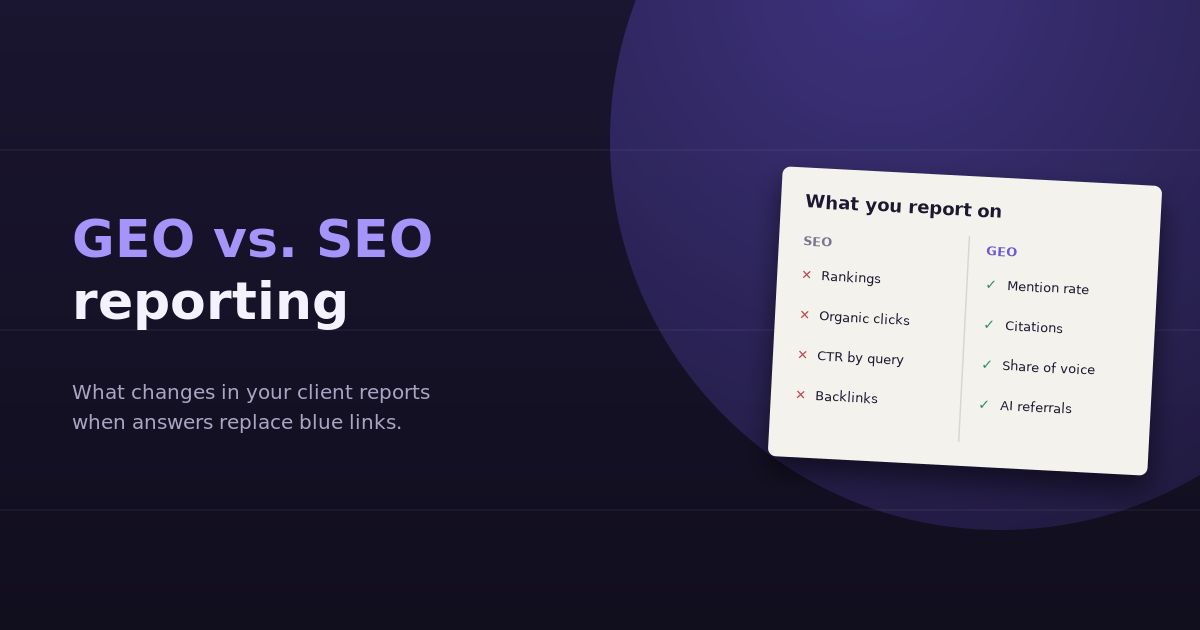
Clients are starting to ask a question that traditional SEO reports can’t answer: “Do we show up when people ask ChatGPT?” Generative engine optimization, or GEO, is the practice of improving how often a brand is mentioned and cited in AI-generated answers. Understanding GEO vs SEO reporting comes down to this: SEO reports measure positions and clicks from search results, while GEO reports measure presence inside answers. Most clients now need both, presented in a way that shows how they relate.
This guide covers what stays the same, what changes, how to structure a combined report, and how to explain the new metrics to clients without overselling them.
What SEO Reporting Measures
A typical SEO report answers questions about visibility and traffic from search results:
- Which keywords do we rank for, and where?
- How many impressions and clicks did organic search generate?
- What’s the click-through rate by query and page?
- How much organic traffic converted?
- How healthy is the site technically, and how is the backlink profile growing?
These metrics assume a results page with ranked links, where visibility leads to clicks and clicks lead to conversions. That model still describes a large share of search behavior. It just no longer describes all of it.
What GEO Reporting Measures
GEO reporting answers questions about presence in AI-generated answers:
- How often is the brand mentioned when people ask relevant questions?
- How often is the brand’s content cited as a source?
- How does that compare with competitors?
- Is the brand described accurately and favorably?
- How much traffic arrives from AI assistants, and does it convert?
The key shift is that GEO metrics are sample-based. There’s no single “rank” for a brand in ChatGPT; there’s a rate at which it appears across many prompts, tracked over time. Our guide to AI visibility metrics covers each one in detail.
Side by Side
| Dimension | SEO reporting | GEO reporting |
|---|---|---|
| Unit of visibility | Ranking position for a keyword | Mention or citation in an answer |
| Data source | Search Console, rank trackers, GA4 | Sampled AI answers, AI visibility tools, GA4 AI referrals |
| Competitive view | Who ranks above you | Share of voice across tracked brands |
| Traffic signal | Organic sessions | AI referral sessions (an undercount of influence) |
| Stability | Fairly stable day to day | Variable; needs trends and ranges |
| Main levers | Content, technical SEO, links | Extractable content, third-party presence, entity consistency, freshness |
What Doesn’t Change
It’s tempting to treat GEO as a replacement for SEO. It isn’t, for practical reasons:
- Many AI systems retrieve information from the web, so strong, crawlable, well-ranked content still feeds AI answers
- Organic search still drives the majority of search-based traffic for most sites
- Conversions still happen on your site, so GA4 measurement remains the bottom line
- Technical health, content quality, and authority matter for both
The change is additive: GEO metrics extend the report to cover a new surface, and explain some changes in SEO metrics that would otherwise look unexplained.
How GEO Explains Changes in SEO Metrics
One of the most valuable things GEO reporting does is make sense of SEO patterns clients are already seeing:
- Stable rankings, falling CTR: often caused by AI Overviews answering the query above the organic results. Reporting AI Overview presence and brand inclusion explains the drop.
- Rising branded search: can reflect discovery that started in an AI assistant and finished on Google.
- Growing direct traffic to deep pages: may include AI referrals that arrive without referrer data.
Without GEO context, these show up as unexplained anomalies. With it, they become part of a coherent story.
Structuring a Combined Report
A practical monthly structure that works for most clients:
1. Executive summary
Three to five bullets covering organic performance, AI visibility, and what’s being done next.
2. Organic search performance
Clicks, impressions, CTR, and average position from Search Console; organic sessions and key events from GA4; top gaining and losing pages.
3. AI visibility
Mention rate, citation rate, and share of voice versus named competitors, trended monthly, segmented by engine and by prompt type.
4. AI referral traffic
Sessions from AI assistants in GA4, top landing pages, and conversion rate compared with organic search.
5. What we changed and what’s next
Content updates, technical fixes, and third-party work, linked to the metrics they’re intended to move.
Keep sections 3 and 4 separate. Visibility and traffic are different things, and merging them hides the fact that most AI exposure never produces a click. For general report structure, our agency reporting tips cover how to keep reports focused on decisions.
Explaining GEO Metrics to Clients
New metrics need careful framing, or they create unrealistic expectations:
- Explain that numbers are samples. “We tracked 120 questions your customers ask, across four AI assistants. You appeared in 26% of answers.”
- Lead with competitors. Share of voice is easier to grasp than an absolute rate.
- Show trends, not snapshots. A single month’s number means little; three months shows direction.
- Be honest about attribution. AI visibility influences decisions that analytics can’t fully trace. Say so.
- Tie it to actions. Every metric should connect to something you’re doing to move it.
Common Reporting Mistakes
- Reporting a single prompt as proof. “ChatGPT recommended us!” from one screenshot isn’t a metric.
- Changing the prompt set every month, which makes trends meaningless
- Counting AI referral traffic as the whole GEO story, which badly understates visibility
- Dropping SEO metrics to make room, when organic search is still usually the bigger traffic source
If you’re building the SEO side of the report from scratch, our SEO dashboard examples are a good starting point.
Frequently Asked Questions
What is the difference between GEO and SEO?
SEO focuses on ranking pages in traditional search results to earn clicks. GEO, or generative engine optimization, focuses on how often a brand is mentioned and cited inside AI-generated answers. They overlap heavily, since many AI systems draw on web content that SEO work improves.
Does GEO replace SEO?
No. Organic search still drives most search-based traffic for most sites, and strong SEO content often feeds AI answers. GEO adds a new layer of visibility to measure and improve alongside SEO.
What metrics should a GEO report include?
At minimum: mention rate, citation rate, and share of voice against named competitors, tracked across a stable set of prompts and segmented by AI engine, plus AI referral traffic and conversions from GA4.
How often should GEO metrics be reported?
Monthly works well. AI answers vary from day to day, so monthly trends based on a consistent prompt set are much more reliable than weekly snapshots.
Can I measure GEO results with Search Console?
Partly. Search Console doesn't report AI assistant mentions, but it can show indirect signals such as changes in CTR on queries with AI Overviews and growth in branded search impressions.
How do I explain falling organic CTR to clients?
Check whether AI Overviews or other SERP features now appear for the affected queries. If rankings are stable and CTR fell, show that the change is in the results page layout, and report whether the brand is included in those AI answers.
Build one report from both worlds. Connect Search Console, GA4, and your SEO data to ConvoData and ask how organic clicks, AI referrals, and branded search moved together this month, then act on what you find from the same chat. Plans start at $39/month.