


When someone asks ChatGPT, Perplexity, Gemini, or Google’s AI Overviews which tool to use, your brand is either in the answer or it isn’t. Traditional SEO metrics don’t capture that. Rankings measure positions in a list of links; AI answers often don’t have a list. AI visibility metrics fill that gap by measuring how often your brand is mentioned, cited, and recommended inside AI-generated answers, and how that compares with your competitors.
This guide covers the core metrics, how to build a prompt set that makes them meaningful, how to measure them, and how to report them without overreacting to noise.
Why AI Visibility Needs Its Own Metrics
AI answers behave differently from search results in three ways that matter for measurement:
- There’s often no click. The user gets an answer and moves on, so traffic-based metrics miss most of the exposure.
- Answers vary. The same question can produce different answers depending on the model, the phrasing, location, and even when you ask.
- Mention and citation are different things. An AI can recommend your brand without linking to you, or link to your content without naming you as a recommendation.
That means you need metrics based on samples of answers, tracked over time, rather than single snapshots.
The Core AI Visibility Metrics
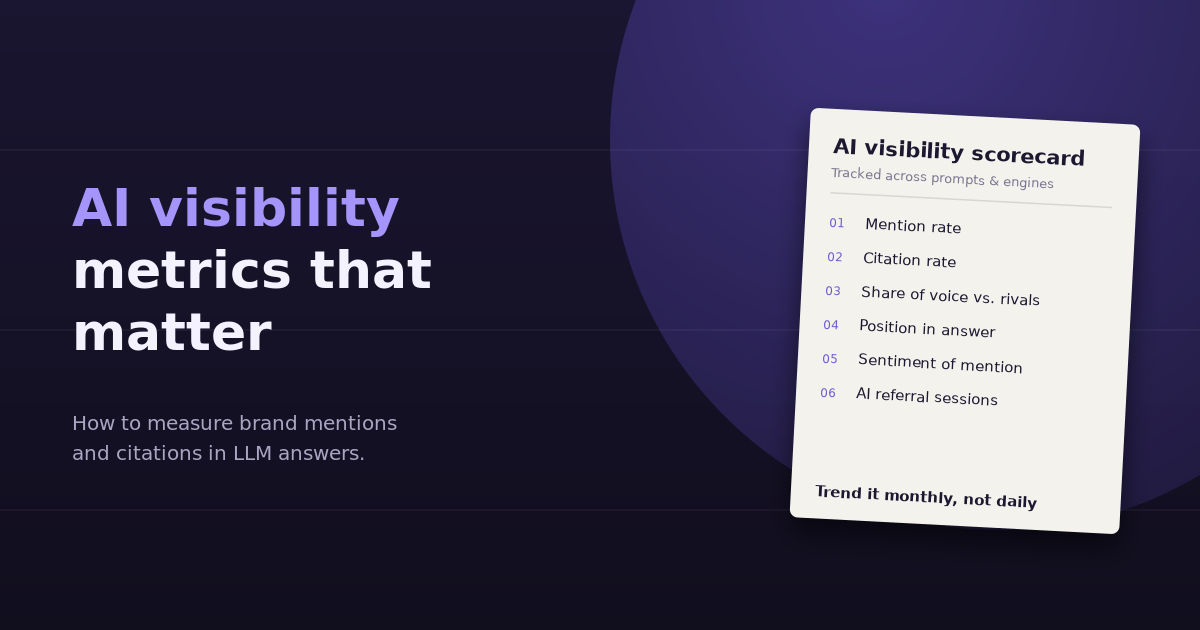
| Metric | What it measures | How to calculate |
|---|---|---|
| Mention rate | How often your brand is named in answers | Answers mentioning your brand ÷ total answers sampled |
| Citation rate | How often your pages are linked as sources | Answers citing your domain ÷ total answers sampled |
| Share of voice | Your mentions relative to competitors | Your mentions ÷ all tracked brands’ mentions |
| Position in answer | How prominently you’re mentioned | Average order of first mention among named brands |
| Sentiment and framing | Whether mentions are positive, neutral, or negative, and accurate | Manual or automated classification of each mention |
| Cited pages | Which of your URLs AI engines rely on | Count of citations by URL |
| AI referral sessions | Visits arriving from AI assistants | GA4 sessions from AI assistant sources |
Mention rate
The headline metric. If you sample 100 answers to relevant questions and your brand appears in 23, your mention rate is 23%. It’s the closest AI-era equivalent to “are we visible for this topic?”
Citation rate
Citations show that an AI engine is using your content as evidence. A high citation rate with a low mention rate often means your content is trusted for facts, but you’re not being recommended. That’s a positioning gap, not a content gap.
Share of voice
Visibility is relative. A 20% mention rate is strong if competitors sit at 5%, and weak if the market leader appears in 70% of answers. Track a defined set of competitors consistently.
Position in answer
Being the first brand named in a recommendation list carries more weight than being the fifth. Average position of first mention captures that prominence.
Sentiment and framing
Mentions aren’t automatically good. Check whether the AI describes your product accurately, which use cases it associates you with, and whether any outdated or wrong information keeps appearing.
Cited pages
Knowing which URLs get cited tells you which content works for AI engines, and which important pages never get used.
AI referral sessions
The traffic side of the picture, measured in GA4. It undercounts influence but connects visibility to on-site behavior and conversions. Our guide to tracking AI traffic in GA4 covers the setup.
Building a Prompt Set That Makes the Metrics Meaningful
AI visibility metrics are only as good as the questions you track. A useful prompt set:
- Reflects real buyer questions. “Best tool for X,” “X vs Y,” “how do I do Z,” and “is X worth it” style questions, in the words your customers use
- Covers the funnel. Informational prompts (how to measure ROAS), comparison prompts (best marketing analytics tools for agencies), and brand prompts (what is your product)
- Is big enough to average out noise. Dozens of prompts per topic, not three or four
- Stays stable. Changing the prompt set every month makes trends meaningless; add prompts in batches and keep the core list fixed
Group prompts by topic or product line so you can see where visibility is strong and where it’s missing.
How to Measure
Manual sampling
Run your prompt set in each AI engine you care about, record whether your brand is mentioned and cited, and note competitors. This is free and teaches you a lot about how answers are structured, but it’s slow and hard to repeat consistently.
Dedicated AI visibility tools
A growing category of tools runs prompt sets automatically across multiple engines on a schedule, records mentions and citations, and calculates share of voice. Several SEO platforms have added AI visibility tracking as well. These make trend tracking practical, but costs scale with the number of prompts and engines.
Combine with your own analytics
Visibility data becomes much more useful when it sits next to GA4 referral traffic and Search Console branded impressions. A rise in mention rate followed by growth in branded searches and AI referrals is a much stronger signal than any one metric alone.
Reading the Numbers Without Overreacting
- Trend monthly, not daily. Answers fluctuate; daily changes are mostly noise.
- Look at ranges, not single values. A mention rate moving from 18% to 21% on a small prompt set may not be a real change.
- Segment by engine. Visibility can be strong in one assistant and absent in another, because they use different sources and retrieval methods.
- Segment by prompt type. Strong in informational prompts but weak in comparison prompts is a common and actionable pattern.
What Moves AI Visibility
Metrics are only useful if you can act on them. The levers that most often influence AI visibility:
- Clear, extractable content: direct answers, definitions, comparison tables, and specific facts that are easy to quote
- Third-party presence: reviews, listings, comparisons, and discussions on sites AI engines draw from
- Consistent entity information: the same product description, category, and positioning across your site and profiles
- Freshness: updated pages for topics where recency matters
- Technical access: making sure AI crawlers aren’t blocked from content you want cited
When you report visibility, tie changes back to these actions so the metrics drive decisions rather than just describing the situation. Our guide to GEO vs SEO reporting covers how to fit these metrics into client reports, and our breakdown of SEO KPIs covers the traditional metrics they sit beside.
Frequently Asked Questions
What is AI visibility?
AI visibility is how often and how prominently your brand appears in answers generated by AI assistants and AI search features, including mentions, recommendations, and citations of your content.
What's the difference between a mention and a citation in AI answers?
A mention is when the AI names your brand in its answer. A citation is when it links to or references your page as a source. You can be cited without being recommended, and recommended without being cited.
How many prompts do I need to track AI visibility reliably?
Enough to average out the natural variation in AI answers. Dozens of prompts per topic is a reasonable minimum, kept stable over time so month-to-month trends are comparable.
Which AI engines should I track?
Start with the assistants your audience actually uses, typically ChatGPT, Google AI Overviews and Gemini, Perplexity, and Microsoft Copilot. Track them separately, since visibility often differs significantly between engines.
Can GA4 measure AI visibility?
Only partially. GA4 can measure visits referred by AI assistants, but it can't see mentions that never lead to a click, which is most AI exposure. Visibility tracking requires sampling AI answers directly.
How often should AI visibility be reported?
Monthly is a good default. AI answers fluctuate day to day, so monthly trends with consistent prompt sets are far more reliable than daily or weekly snapshots.
Put AI visibility next to the rest of your data. Connect GA4, Search Console, and your SEO tools to ConvoData and ask how AI referrals, branded searches, and organic performance are moving together, then act on it from the same chat. Plans start at $39/month.