


A social media handle is the first thing a customer types when they’re looking for your brand online — and if it’s inconsistent, misspelled, or already taken on half your platforms, that search ends in the wrong place.
Handles seem like a small detail until a rebrand, a new platform launch, or a customer complaint about not being able to find you forces the issue.
This guide covers what a handle actually is, how it differs from a username or display name, platform-specific rules, and what to do when your ideal handle isn’t available everywhere.
It also covers a detail agencies and in-house teams often skip: how to actually keep track of handle performance and mentions once you’ve got them set up consistently.
What Is a Social Media Handle?
A social media handle is the unique, public username that identifies an account on a platform, usually preceded by an @ symbol — like @yourbrand. It’s how people tag, search for, and mention you, and it’s typically separate from your display name.
A handle is the unique identifier attached to your account, distinct from your display name (which can contain spaces, emojis, and full words, and can be changed freely).
On X (formerly Twitter), Instagram, and TikTok, your handle appears with an @ symbol — @yourbrand. On Facebook, it shows up as part of your page URL — facebook.com/yourbrand. On LinkedIn, it’s the custom URL slug on your company page.
Handles matter because they’re what people type to find you, what gets used to tag you in posts and comments, and often what shows up in a search engine result alongside your brand name.
Handle vs. Username vs. Display Name
These three terms get used interchangeably, but they’re not the same thing, and mixing them up causes real confusion when setting up new accounts.
Your username and handle are generally the same thing — the unique string tied to your account that can’t be duplicated by anyone else on that platform. Your display name is the friendlier, changeable label shown above your posts.
Handle/username: @yourbrand — unique, used for tagging and mentions, harder to change without breaking existing links.
Display name: “Your Brand Co.” — can include spaces, emojis, and can be updated anytime without affecting your profile URL.
Bio/description: separate field entirely, used for context, not for identification or tagging.
Should Your Handle Be Consistent Across Platforms?
Yes — using the same or a near-identical handle across every platform makes your brand easier to find, easier to tag, and harder to impersonate. Inconsistent handles like @BrandCo on one platform and @TheBrandCompany on another confuse customers trying to confirm they’ve found the real account.
Consistency is the single most important rule in handle selection. When a customer finds you on Instagram and assumes the same handle works on X, an inconsistent handle sends them to the wrong account — or to no account at all.
It also protects against impersonation. A consistent handle makes it obvious which account is official, and makes any lookalike account easier for both customers and your team to spot and report.
Perfect consistency isn’t always possible due to character limits or prior registrations, but staying as close as possible — same core name, same capitalization pattern, same separator style — keeps the brand recognizable everywhere.
How to Choose a Strong Social Media Handle
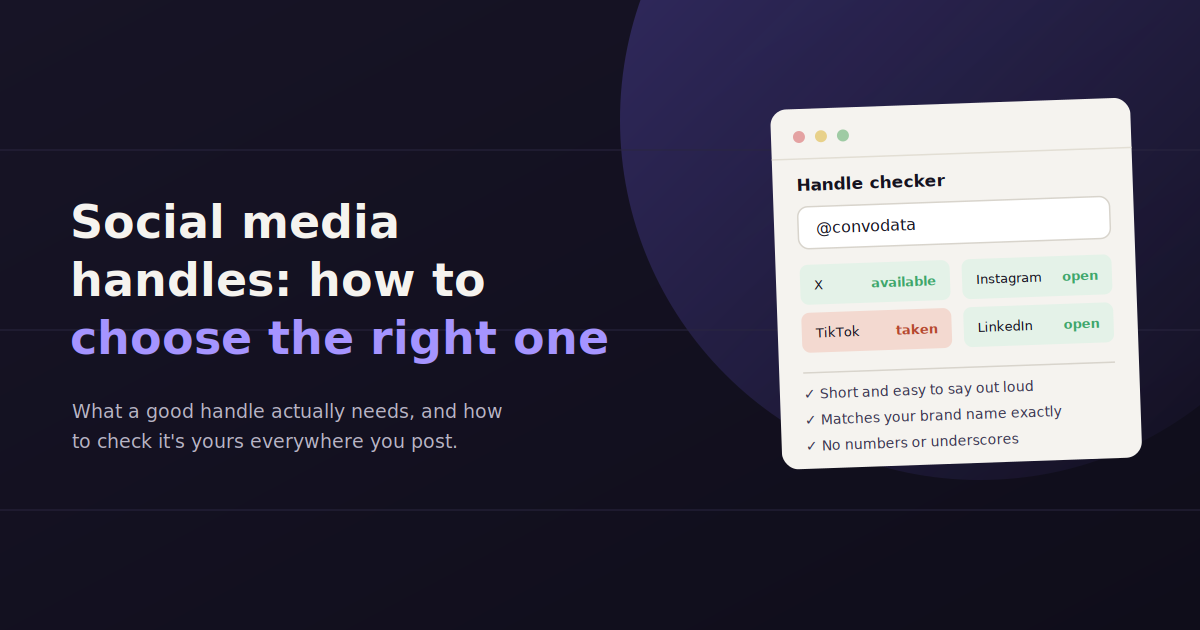
Match your brand name as closely as possible — the handle should be recognizable at a glance, not require explanation.
Keep it short — shorter handles are easier to remember, easier to type, and less likely to run into character limits on platforms like X.
Avoid numbers unless they’re part of your actual brand name — “@brandco123” reads as a workaround, not an intentional choice, and looks less credible.
Skip special characters where possible — underscores and periods are sometimes necessary, but they add friction every time someone types your handle from memory.
Check availability everywhere before committing — search every platform you might realistically use in the next two years, not just the ones you’re active on today.
What to Do If Your Handle Isn’t Available Everywhere
If your ideal handle is taken on a platform, add a short, brand-relevant descriptor or location instead of random numbers — for example @yourbrandHQ or @yourbrandNYC. This keeps the handle recognizable and intentional rather than looking like a workaround.
This happens to nearly every brand eventually, especially common words or short names that were claimed years ago. The fix is to add something meaningful, not arbitrary.
A short, brand-relevant word reads as intentional. Random numbers tacked onto the end read as an accident — and they’re harder for customers to guess or remember correctly.
Add a location: @yourbrandNYC, @yourbrandUK
Add a category descriptor: @yourbrandHQ, @getyourbrand, @yourbrandApp
Use a single separator, consistently: an underscore or period, applied the same way on every platform where you need one
Avoid: random number strings, misspellings, or anything a customer would have to guess character-by-character
Platform Character Limits and Handle Rules
Every major platform enforces its own length and character rules, and they change from time to time — always confirm current limits in the platform’s own help documentation before finalizing a handle, especially for a new account.
As a general guide, shorter platforms like X have historically been the tightest constraint, since a short character limit there often ends up dictating the handle you use everywhere else for consistency.
| Platform | General Handle Format | Typical Constraint |
|---|---|---|
| X (Twitter) | @handle | Among the shortest limits of major platforms |
| @handle | Longer allowance than X, supports periods and underscores | |
| TikTok | @handle | Similar range to Instagram |
| facebook.com/handle | Set once a Page reaches a follower threshold | |
| linkedin.com/company/handle | Custom URL slug, generally more flexible length | |
| pinterest.com/handle | Shorter allowance, similar to X |
Changing or Rebranding a Handle: What to Consider
Changing a handle after you’ve built an audience is riskier than picking the right one from the start, but sometimes a rebrand makes it unavoidable.
Before changing, set up redirects or update pinned posts pointing to the new handle, and expect a temporary dip in tag accuracy while old mentions and saved links still point to the previous name.
Old handles on most platforms don’t automatically become available to squatters the moment you change yours, but policies vary — check the specific platform’s rules so a competitor or impersonator can’t claim your old handle the day you drop it.
Monitoring Your Handles and Mentions Across Platforms
Choosing a consistent handle solves half the problem. The other half is actually keeping track of how each platform’s account is performing and who’s mentioning you, without logging into five separate apps every day.
This is where reporting tools typically enter the picture, pulling follower counts, engagement, and mention data into one place instead of leaving it scattered across platform-native analytics tabs.
A conversational tool like ConvoData fits naturally here — instead of building a social dashboard, you can ask directly, “how did our Instagram and X handles perform this month” or “which platform is driving the most engagement,” and get a live answer pulled from your connected accounts, plus a suggested next step. It currently supports 14 live integrations out of a 27-integration roadmap, so it’s worth confirming your specific platforms are covered before relying on it as your only reporting layer.
Reserving Handles Before You Actually Need Them
One of the cheapest, most overlooked pieces of brand protection is reserving your handle on a platform you have no immediate plans to use. It costs nothing but a few minutes of setup, and it closes off a problem that’s expensive to fix later.
A common scenario: a brand launches on Instagram and X, ignores TikTok for two years, and then discovers when they’re finally ready to launch there that the handle is either taken by an unrelated account or, worse, by someone impersonating the brand and posting under the name.
A reasonable practice is claiming your core handle on every major platform relevant to your industry the moment you register a domain or file for a trademark, even if the account itself stays empty for years. An unused, correctly named account with a link back to your actual website is far easier to maintain than reclaiming a handle from a third party after the fact, which can require a lengthy platform dispute process with no guaranteed outcome.
Protecting Your Handle From Impersonation
A consistent, verified handle is itself a form of protection, but it’s worth pairing with a few active habits rather than assuming the handle alone deters impersonators.
Apply for platform verification where it’s available, since a verified badge gives customers an immediate, visible way to distinguish the real account from a copycat. Periodically search your brand name across each platform, not just check your own handle, to catch lookalike accounts using a near-identical spelling or a slightly different separator.
When an impersonating account is found, most platforms have a dedicated reporting flow for brand impersonation that moves faster than a general abuse report — using the correct reporting category matters more than people expect, since a misclassified report can sit in a slower general queue for weeks.
Common Mistakes Brands Make with Social Media Handles
Choosing different handles per platform without checking whether a consistent version was available everywhere first.
Adding random numbers instead of a meaningful descriptor when the ideal handle is taken.
Forgetting to reserve handles on platforms you’re not using yet — a competitor or squatter claiming your brand name on a platform you plan to launch on later is a preventable problem.
Changing a handle without redirects or advance notice, causing customers and tagged mentions to land on a dead or renamed account.
Frequently Asked Questions
What is the difference between a social media handle and a username?
In most contexts they mean the same thing — the unique identifier tied to your account, usually shown with an @ symbol, that's distinct from your changeable display name.
Should my social media handle match my business name exactly?
As closely as possible. An exact match makes your brand easiest to find, but when it's unavailable, a short, meaningful addition like a location or category word is better than random numbers.
Can I change my social media handle later?
Yes, on most platforms, but changing it after building an audience risks temporary confusion — old links, tags, and saved mentions may not immediately point to the new handle, so set up redirects or a pinned post announcing the change.
Why do some platforms limit handles to so few characters?
Shorter character limits, especially on platforms like X, are meant to keep handles easy to type and read within tight post character counts — this is also why a short handle is worth prioritizing even on platforms with more generous limits.
What should I do if my exact brand name is taken on every platform?
Add a short, intentional descriptor — a location, a category word, or 'HQ' — rather than numbers or misspellings, and keep that same addition consistent across every platform where you need it.
How do I track how my social media handles are performing across platforms?
Most teams either check each platform's native analytics individually or centralize the data in a reporting tool. A conversational option like ConvoData lets you ask directly which handle or platform performed best, pulling the answer live from your connected accounts instead of requiring a separate dashboard for each one.
Should I reserve a handle on a platform I'm not using yet?
Yes. Claiming your core handle on every major relevant platform as soon as you register a domain or trademark costs almost nothing and prevents a competitor or impersonator from taking it before you're ready to launch there, which can be far harder to reclaim later.
Once your handles are consistent, the next step is knowing how each one is actually performing without checking five different apps. Connect your social accounts to ConvoData and ask it which platform is driving the most engagement this month — plans start at $39/month.
Once your handles are locked in and consistent, the real work is tracking whether each platform is actually earning its place — our guide to the social media KPIs that actually matter covers what to watch. If Facebook is part of that mix, see our breakdown of 15 Facebook metrics to track for platform-specific detail.