


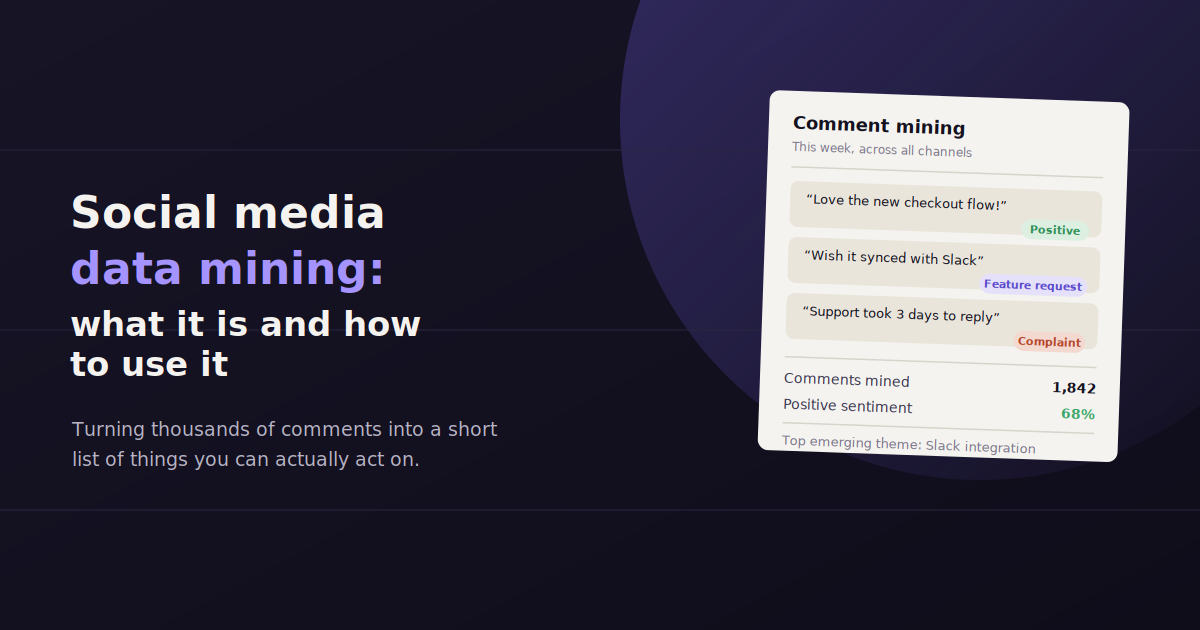
Every like, comment, and share on social media is a data point — the question is whether your team is actually using that data or just watching it scroll by.
Social media data mining is the process of extracting patterns and insights from that raw activity to inform real marketing decisions, not just vanity reporting.
Done well, it tells you what content resonates, who your audience actually is, and where a campaign is about to underperform before the budget is fully spent.
This guide covers what data gets collected, how the mining process works, who uses it, and the ethical lines worth respecting.
What Is Social Media Data Mining?
Social media data mining is the process of collecting and analyzing large volumes of social platform data — posts, engagement, demographics, sentiment — to identify patterns that inform marketing strategy, rather than reviewing metrics one post at a time.
It’s distinct from basic social media reporting. Reporting tells you what happened last month; data mining looks for the pattern behind why it happened and what’s likely to happen next.
With more than half the world’s population active on at least one social platform daily, the volume of available signal is enormous — data mining is what turns that volume into something usable.
What Data Gets Collected for Social Media Data Mining
Engagement data — likes, comments, shares, retweets, saves.
Reach and impressions — how many people saw content, and how often.
Hashtag usage — which tags correlate with higher engagement or reach.
Geographic and demographic data — location, age range, and in some cases profession.
Sentiment signals — the tone of comments and mentions, not just the volume.
How Social Data Mining Actually Works
The process runs through a few consistent stages regardless of platform or tool.
First, data collection pulls raw activity from platform APIs or listening tools. Second, cleaning and structuring removes duplicates and standardizes formats across sources, since a spam comment or a duplicated mention can quietly skew a sentiment score if it isn’t filtered out early. Third, analysis applies techniques like classification, pattern tracking, and sentiment analysis to surface something actionable.
Classification
Sorts content or audience segments into categories — by interest, behavior, or content type — to spot which segment responds best to which message.
Association and Pattern Tracking
Identifies which variables tend to move together — post time and engagement rate, hashtag choice and reach, creative format and click-through rate.
Predictive Analytics
Uses historical patterns to forecast what’s likely to happen with a similar future post or campaign, rather than just describing the past.
Sentiment Analysis
Reads the tone of comments and mentions to gauge whether engagement is actually positive, not just high in volume — a post can go viral for the wrong reasons.
Who Uses Social Media Data Mining, and For What
| User | Primary Use Case |
|---|---|
| Marketing teams | Campaign planning and content strategy |
| Brand managers | Reputation monitoring and crisis detection |
| Product teams | Feature feedback from unprompted mentions |
| Researchers | Trend and public opinion analysis |
| Political and advocacy groups | Sentiment tracking on issues and messaging |
Tools Commonly Used for Social Data Mining
Purpose-built listening tools like Brand Watch and Buffer handle collection and basic sentiment scoring. BI platforms like Sisense, IBM Cognos, and Dundas BI handle deeper cross-source analysis once the data is collected.
Dashboard-centric competitors like Whatagraph sit in between — they centralize social metrics from multiple platforms into a single visual report, which is useful for standard reporting but still requires someone to interpret the dashboard and decide what to do with it. That works well for recurring client reports, but it’s a slower path for the one-off question that needs an answer today.
For teams that want to skip building a dashboard around this data, ConvoData offers a conversational alternative — connect a social data source and ask a direct question, like which post format drove the most engagement last month, and get an answer plus a recommendation instead of a raw export to interpret yourself.
Common Social Media Data Mining Use Cases in Practice
Content Strategy Optimization
Pattern tracking across months of posts reveals which formats, topics, and posting times consistently outperform, replacing guesswork with a repeatable content calendar.
Crisis and Reputation Monitoring
Sentiment analysis run continuously can flag a negative shift in brand mentions hours before it would surface through manual monitoring, giving a team time to respond before it compounds.
Competitive Benchmarking
Mining publicly available competitor activity — posting frequency, engagement rate, campaign timing — provides context for whether your own numbers are actually strong or just average for the category.
Audience Segmentation
Classification techniques applied to follower and engager data can surface sub-segments within an audience that respond to different messaging, sharpening targeting beyond basic demographics.
Social Media Data Mining vs. Social Listening vs. Social Analytics
The three terms get used interchangeably, but they describe different scopes of work — and knowing which one you actually need saves time picking a tool.
In practice, the three overlap. A listening tool feeds the raw mentions data that a mining process later analyzes for patterns; an analytics dashboard reports the same engagement numbers that a mining model uses as training data for predictions. Most teams don’t need to pick one — they need social listening for speed, analytics for standard reporting, and data mining for the questions that require looking across months of history rather than the current week.
| Term | Scope | Best For |
|---|---|---|
| Social listening | Real-time monitoring of mentions and sentiment | Catching a PR issue or trending topic early |
| Social analytics | Reporting on your own account’s performance metrics | Tracking engagement, reach, and growth over time |
| Social data mining | Pattern recognition and prediction across large historical datasets | Strategic decisions — content strategy, audience segmentation, forecasting |
Common Mistakes in Social Media Data Mining
Mining data without a question in mind. Pulling every available metric and looking for something interesting produces false patterns more often than real ones — start with a specific hypothesis to test.
Ignoring sample size. A pattern based on 20 posts isn’t a pattern yet; drawing conclusions from a small dataset is one of the fastest ways to build a content strategy around noise.
Treating correlation as causation. Posts with more hashtags getting more engagement doesn’t mean hashtags caused it — posting time, topic, or format could be the actual driver, and mining tools rarely isolate that on their own.
Skipping data cleaning. Bot accounts, duplicate mentions, and spam comments inflate engagement and sentiment numbers if they aren’t filtered out before analysis.
Analyzing in a silo. Social data mined without cross-referencing website traffic, conversions, or sales data tells you what happened on the platform, not what it meant for the business.
Building a Social Data Mining Workflow, Step by Step
1. Define the business question first. “What content drives the most engagement” is too broad — “which post format drove the most link clicks to product pages last quarter” is answerable.
2. Choose the data sources that actually bear on the question. More platforms isn’t automatically better; a question about Instagram content performance doesn’t need LinkedIn data mixed in.
3. Set a consistent time window. Comparing this month’s data against a full year of history without normalizing for seasonality produces misleading trend lines.
4. Clean before analyzing. Remove bot engagement, duplicate mentions, and clearly irrelevant results before running any pattern detection.
5. Test the pattern against a second period. A trend that held for one month and breaks the next is noise, not a strategy input — validate before committing budget to it.
6. Turn the finding into one specific action. A workflow that ends in an insight but no decision hasn’t actually paid for itself yet.
Getting Started With Social Media Data Mining
You don’t need a data science team to start. Most teams get real value from three steps: pick one platform to focus on first, define the specific question you want answered, and choose a tool that fits your team’s technical comfort level rather than the most feature-rich option available.
Start narrow. Mining every available data point across five platforms at once produces more noise than insight — a focused question on one channel, answered well, is more useful than a sprawling dashboard nobody fully reads. Once that first question has a clear, validated answer, expanding to a second platform or a second question is a much smaller lift than trying to stand up a full cross-channel mining process from day one.
Is Social Media Data Mining Ethical?
Social media data mining is generally ethical when it uses publicly available or platform-permitted data, respects user privacy expectations, and complies with each platform’s terms of service and applicable data protection laws — problems arise with scraping private data or de-anonymizing individuals without consent.
The ethical line usually comes down to consent and expectation. Mining publicly posted content for aggregate trends is broadly accepted; using it to build individual profiles without disclosure is where most privacy concerns start.
Platform terms of service also matter practically, not just ethically — violating a platform’s API terms can get access revoked entirely, which is its own kind of risk to plan around.
A useful internal test: if the analysis only reports aggregate patterns — what percent of comments were positive, which posting time performs best — it’s on solid ground. The moment the output could identify or profile a specific individual without their knowledge, it’s worth a second look regardless of whether the data was technically public.
Frequently Asked Questions
What is the difference between social media data mining and social listening?
Social listening typically focuses on monitoring mentions and sentiment in real time, catching a spike or a shift as it happens; data mining is broader, applying pattern recognition and predictive analysis across larger historical datasets to inform longer-term strategy rather than reacting to the current moment.
Is social media data mining legal?
Generally yes, when using data available through official platform APIs and complying with each platform's terms of service and relevant privacy laws — unauthorized scraping or bypassing API limits carries legal and access risk.
What's the easiest way to start social media data mining without a data team?
Start with a listening or analytics tool that handles collection automatically, then layer in a conversational tool like ConvoData to ask direct questions about the data instead of building custom analysis from scratch.
Can small businesses benefit from social media data mining?
Yes — even basic pattern tracking, like which post types get more engagement or what time your audience is most active, doesn't require enterprise-scale tools to be useful.
How much historical data do you need before patterns are reliable?
There's no fixed number, but most patterns need to hold across at least a few dozen posts or several months of activity before they're trustworthy. A trend based on two or three posts is far more likely to be coincidence than a real signal worth building strategy around.
Does social media data mining work for B2B brands with smaller audiences?
Yes, though smaller datasets mean patterns take longer to become statistically reliable. B2B teams often get more value mining engagement quality — who is commenting, what job titles are engaging — than raw volume metrics, since B2B audiences are smaller but each engagement carries more signal.
What's the biggest risk of relying too heavily on social media data mining?
Over-indexing on what's measurable at the expense of what matters. Engagement and reach are easy to mine because the data is abundant, but they don't always correlate with revenue — a data mining process that never gets checked against actual business outcomes can optimize a team toward metrics that look good without moving the business.
Connect your social accounts to a data mining or conversational tool like ConvoData and ask it one real question about your audience this week — plans start at $39/month.
Data mining works best on a foundation of clean, consistent collection — see our complete guide to social media data collection if that groundwork is not in place yet. Once the insights are flowing, our guide to the social media KPIs that actually matter covers which numbers to actually act on.