


A direct marketing channel is any way a business reaches an individual customer directly, with a message and offer meant for them specifically, rather than broadcasting to a general audience through mass media.
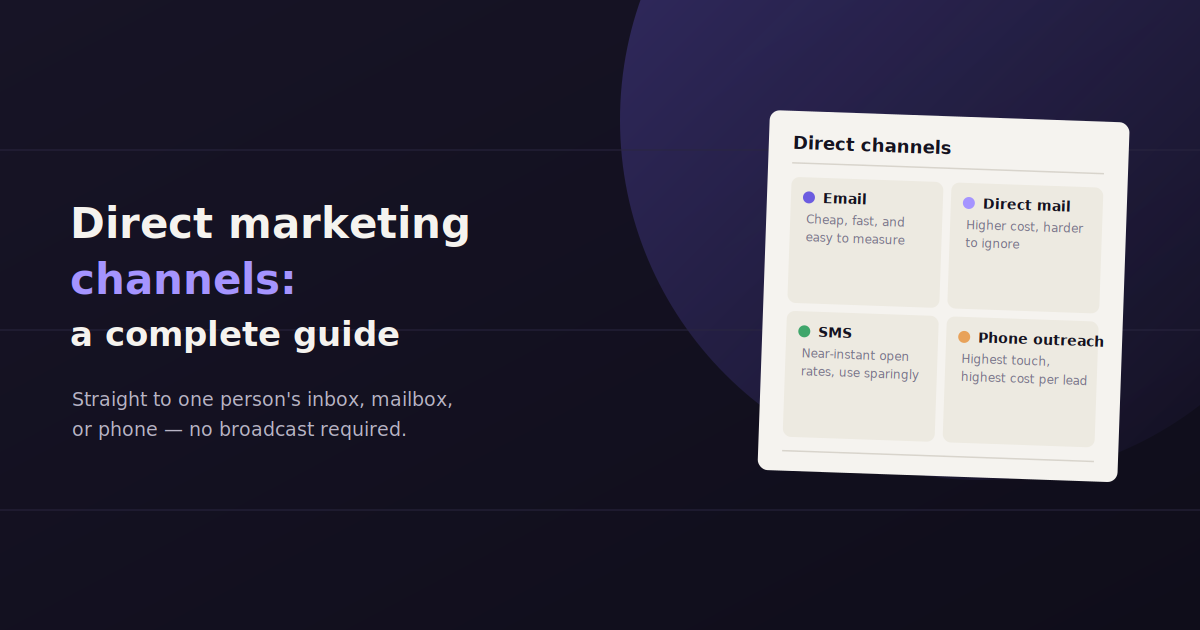
Email, direct mail, SMS, and telemarketing are the classic examples, and despite decades of new channels arriving, all four are still in active use — often performing better than their reputation suggests when run with clean data and clear measurement.
This guide covers each major direct marketing channel, its real pros and cons, and how to actually measure and report on performance so these campaigns get judged on results rather than assumptions.
The through-line across every channel here is personalization and direct response — a direct marketing message is built to reach a known person and prompt a specific, trackable action.
What Counts as a Direct Marketing Channel
Direct marketing is defined by two things: it targets a specific, identifiable recipient, and it typically asks for a direct, measurable response — a click, a call, a purchase, a reply. That’s what separates it from mass marketing, which broadcasts one message to an undifferentiated audience with no individual targeting.
The category includes both digital and traditional channels. Email and SMS feel modern; direct mail and telemarketing feel dated to some marketers, but all four share the same core mechanic of reaching a known contact with a tailored offer.
What makes direct marketing worth a dedicated strategy today is data. Every channel below can be personalized, segmented, and measured with far more precision than it could 20 years ago, because the contact data feeding these campaigns is richer and more current than it used to be.
The Main Direct Marketing Channels
The core direct marketing channels are email, direct mail, SMS, and telemarketing — each reaching a specific individual with a personalized offer and a measurable call to action. Email and SMS offer the lowest cost and fastest turnaround, while direct mail and telemarketing offer higher per-contact impact at a higher cost.
Each channel below plays a different role depending on the offer, the audience, and the budget. None of them work identically, and the strongest direct marketing programs typically use two or three in combination rather than relying on just one.
Email Marketing
Email remains the highest-volume direct marketing channel for most businesses, largely because it’s inexpensive to send at scale and easy to personalize using data already sitting in a CRM or ecommerce platform.
It supports fine-grained segmentation — by purchase history, browsing behavior, lifecycle stage, or engagement level — and every send generates trackable data on opens, clicks, and conversions almost immediately.
Pros: low cost per contact, fast turnaround, strong built-in tracking, easy A/B testing
Cons: inbox fatigue and rising spam filters make deliverability an ongoing challenge; open rates keep getting harder to trust as privacy features mask real engagement
Direct Mail
Direct mail sends a physical piece — postcard, catalog, letter — to a specific address. It’s the most tactile channel on this list, and that physicality is exactly what makes it stand out in an inbox-saturated world.
It costs meaningfully more per contact than email or SMS due to printing and postage, which usually means direct mail gets reserved for higher-value offers or customers, where the higher cost per piece is justified by a higher expected return.
Pros: high attention and low competition for physical mailbox space, strong performance for high-consideration or high-value offers, no deliverability or spam-filter risk
Cons: highest cost per contact of the major direct channels, slower turnaround from print to delivery, harder to test and iterate quickly
SMS Marketing
SMS reaches a customer’s phone directly with a short, immediate message — appointment reminders, flash sale alerts, order updates, or time-sensitive offers all fit the format well.
Open rates for SMS are notably higher than email, largely because text messages get read within minutes for most recipients, but that same immediacy makes over-messaging feel intrusive fast.
Pros: extremely high open and read rates, near-instant delivery, well suited to time-sensitive offers
Cons: strict character limits constrain messaging, requires explicit opt-in under most regulations, easy to fatigue a list if overused
Telemarketing
Telemarketing — outbound or inbound phone-based sales and service calls — is the most personal and highest-touch channel on this list, allowing real-time conversation, objection handling, and immediate closing in a way no other direct channel can match.
It’s also the most resource-intensive, requiring trained staff time per contact rather than a single campaign send reaching thousands of people at once, which puts a natural ceiling on scale.
Pros: highest per-contact conversion potential due to real-time interaction, allows immediate objection handling and upselling, well suited to complex or high-value offers
Cons: highest cost per contact by far, heavily regulated (do-not-call lists, calling-hour restrictions), difficult to scale without proportionally scaling staff
Other Direct Channels Worth Knowing
A few additional channels fit the direct marketing definition and are worth a brief mention, even though they’re used less broadly than the four above.
Direct response print and broadcast — a magazine ad or TV spot with a specific call-to-action code or dedicated phone number — technically counts as direct marketing when it’s built to prompt and track an individual response, even though the initial delivery is broadcast. Push notifications from a mobile app function similarly to SMS but through an app rather than a phone number, and increasingly sit alongside SMS in a unified messaging strategy.
Comparing Direct Marketing Channels
Cost, speed, and personalization depth vary widely across these channels, which is exactly why most direct marketing programs blend more than one rather than picking a single winner.
| Channel | Cost per Contact | Typical Turnaround | Best For |
|---|---|---|---|
| Lowest | Minutes to hours | High-frequency, low-cost engagement and nurture | |
| SMS | Low | Immediate | Time-sensitive offers and reminders |
| Direct mail | Highest | Days to weeks | High-value offers, re-engagement, older demographics |
| Telemarketing | High (labor-intensive) | Immediate | Complex sales, high-value accounts, service follow-up |
The General Pros and Cons of Direct Marketing
Beyond the channel-specific trade-offs, direct marketing as a category has broader advantages and limitations worth weighing against mass marketing or purely inbound approaches.
The biggest advantage across every direct channel is measurability. Because each message goes to a known, identifiable recipient, it’s possible to track exactly who responded, what they did next, and how that ties back to revenue — a level of attribution mass marketing simply can’t offer.
The trade-off is data dependency. Direct marketing is only as good as the contact data behind it — a stale email list, an outdated mailing address, or a bad phone number turns a well-designed campaign into wasted spend, which is why list hygiene and permission management matter as much as the creative itself.
Advantage: precise targeting. Segmentation by past behavior or purchase history means messages reach people with a genuine reason to care.
Advantage: clear attribution. A response can usually be traced back to a specific send, list, or offer, making ROI calculations far more direct than brand advertising.
Advantage: fast iteration. Email and SMS in particular support quick A/B testing, letting a team improve subject lines, offers, or timing within days.
Disadvantage: data decay. Contact lists degrade over time as people change email addresses, phone numbers, and physical addresses, requiring ongoing list maintenance.
Disadvantage: regulatory complexity. Email, SMS, and telemarketing are all subject to consent and opt-out rules (like CAN-SPAM, TCPA, and similar regulations elsewhere), which adds compliance overhead that mass marketing doesn’t carry to the same degree.
How to Measure and Report on Direct Marketing Performance
Direct marketing measurement starts with the same core response metrics across every channel: how many people were reached, how many responded, and how many of those responses turned into revenue.
Response rate is the foundational metric — the percentage of contacts who took the desired action, whether that’s opening an email, clicking a link, replying to a text, or picking up a call. It’s the clearest apples-to-apples way to compare performance across sends within the same channel.
Cost per acquisition matters more once you’re comparing across channels, since direct mail and telemarketing carry much higher per-contact costs than email or SMS — a channel with a lower response rate can still be the more efficient choice if its cost per contact is low enough.
For direct mail specifically, measurement gets trickier because there’s no native click-tracking. Common workarounds include dedicated landing page URLs, unique promo codes printed on each piece, or dedicated phone numbers that route calls back to a specific mailing — all designed to recreate the kind of attribution email gets by default.
Response rate — percentage of contacts who took the desired action, tracked per send or per campaign.
Conversion rate — percentage of responders who completed a purchase or other core goal, not just clicked or opened.
Cost per acquisition (CPA) — total campaign cost divided by conversions, essential for comparing channels with very different per-contact costs.
Customer lifetime value from acquired customers — useful for justifying a higher CPA channel like direct mail or telemarketing when it brings in higher-value customers.
List/database growth and decay rate — how fast a contact list is growing versus how quickly existing contacts go stale or unsubscribe.
Bringing Direct Marketing Data Into One Report
The practical challenge with direct marketing reporting is that the data lives in several disconnected systems — an email service provider, an SMS platform, a direct mail vendor’s response tracking, and a CRM holding the actual conversion and revenue data.
Stitching those together by hand every reporting period is exactly the kind of repetitive work that eats into time better spent improving the campaigns themselves. A conversational reporting tool like ConvoData is built for this kind of cross-channel question — connect your email, SMS, and CRM data sources once, then ask something like “which channel drove the lowest cost per acquisition last month” and get a direct answer instead of exporting three separate reports and reconciling them manually.
Direct marketing sits at the opposite end of the spectrum from mass marketing strategy, and it is worth understanding both to know which fits a given campaign. Since most direct channels lean on a solid contact database, our explainer on what CRM stands for covers the system most of this data ultimately lives in.
Frequently Asked Questions
What is a direct marketing channel?
It's any marketing channel that reaches a specific, identifiable individual with a personalized message and asks for a direct, trackable response — the main examples are email, direct mail, SMS, and telemarketing.
Which direct marketing channel has the highest ROI?
It depends on the offer and audience, but email typically has the lowest cost per contact and strong measurability, making it a common top performer on ROI. High-value or complex offers often see stronger ROI from telemarketing or direct mail despite higher per-contact cost.
Is direct mail still effective in 2026?
Yes, particularly for high-value offers and audiences less saturated by digital ads. Its higher cost per contact is often justified by lower competition for attention and strong performance with older or higher-income demographics.
What's the difference between direct marketing and mass marketing?
Direct marketing targets specific, identifiable individuals with personalized messaging and a trackable response; mass marketing broadcasts one message to a broad, undifferentiated audience without individual targeting.
How do you measure direct mail response without click tracking?
Use dedicated landing page URLs, unique promo codes, or dedicated phone numbers printed on each piece, so a response can be traced back to that specific mailing even without native digital tracking.
What regulations apply to direct marketing channels?
Email is subject to laws like CAN-SPAM, SMS and telemarketing are subject to TCPA and do-not-call regulations in the US, and most channels require explicit consent and an opt-out mechanism, with similar frameworks like GDPR applying in other regions.
Direct marketing performance is only useful once it’s measured properly across every channel. See how ConvoData connects your email, SMS, and CRM data into one place you can query in plain English — plans start at $39/month.