


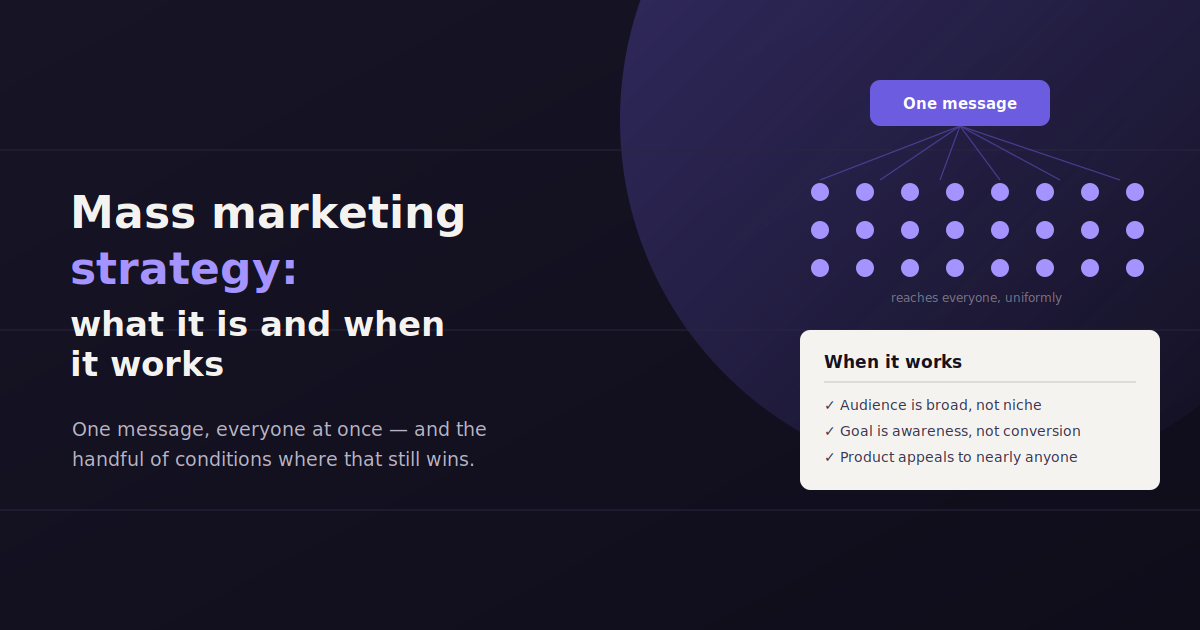
A mass marketing strategy aims a single message at the widest possible audience, on the assumption that broad reach beats narrow precision. Think network TV commercials, billboard campaigns, and national radio spots.
It’s an old approach — older than digital advertising by decades — but it hasn’t disappeared. Some of the largest brands in the world still run mass campaigns alongside their targeted digital spend, because the two strategies solve different problems.
This guide covers what mass marketing actually is, when it makes sense versus a targeted or niche approach, real examples of it in practice, and how to measure whether a mass campaign is working.
The short version: mass marketing trades precision for scale, and that trade only pays off under specific conditions — a broad product, a large budget, and a goal built around awareness rather than immediate conversion.
What Is Mass Marketing?
Mass marketing is a strategy built around one product, one message, and one campaign delivered to as large and undifferentiated an audience as possible. Instead of segmenting an audience by demographics, interests, or behavior, a mass marketing campaign treats the entire market as a single group.
The approach emerged in the mid-20th century alongside the rise of television and national print publications, which for the first time let a single advertiser reach millions of households simultaneously with the same ad.
The underlying logic is economies of scale: producing one piece of creative and distributing it broadly costs less per person reached than producing dozens of tailored versions for different segments. That math worked especially well when media buying itself was already national by default — a 30-second TV spot during a popular show reached a huge, mixed audience whether you wanted it to or not.
Mass Marketing vs. Targeted and Niche Marketing
Mass marketing sends one message to a broad, undifferentiated audience to maximize reach and brand awareness at a lower cost per impression. Targeted and niche marketing segment the audience and tailor messaging to specific groups, trading reach for relevance and typically higher conversion rates.
The core difference between mass marketing and targeted marketing is segmentation. Mass marketing skips it entirely; targeted marketing builds the entire campaign around it, from message to channel to creative.
Niche marketing takes segmentation a step further, focusing on a small, specific subset of the market with highly tailored messaging — think a skincare brand built exclusively for a particular skin condition rather than skincare in general.
Neither approach is inherently better. Mass marketing wins on reach and cost-per-impression; targeted and niche marketing win on relevance, conversion rate, and return on ad spend for a given budget. Most mature companies use some blend of both, weighted toward whichever fits the product and growth stage.
| Factor | Mass Marketing | Targeted/Niche Marketing |
|---|---|---|
| Audience | Entire market, no segmentation | Specific segment or persona |
| Message | One message for everyone | Tailored per segment |
| Typical channels | TV, radio, billboards, national print | Paid search, paid social, email, direct mail |
| Cost per impression | Low | Higher, but more relevant |
| Conversion rate | Lower, harder to measure directly | Higher, easier to attribute |
| Best for | Broad, universal products; brand awareness | Specific products; direct response and ROI-focused goals |
When Mass Marketing Actually Works
Mass marketing tends to work best for products with universal or near-universal appeal — things like soft drinks, fast food, household staples, or insurance, where almost everyone in the audience is a plausible customer.
It also works well when the goal is brand awareness or brand recall rather than an immediate transaction. A Super Bowl ad rarely drives a purchase in the next five minutes, but it builds the kind of familiarity that shows up months later when someone is standing in a store aisle.
Budget is the other deciding factor. Mass marketing channels — national TV, major sponsorships, large-scale outdoor advertising — require substantial spend to reach meaningful frequency. A company with a small budget spread across a mass campaign risks reaching everyone once and nobody enough times to register.
Good Fits for Mass Marketing
Category leaders launching a new product — companies with existing brand equity and distribution can afford broad reach because conversion doesn’t depend on a single ad.
Products with near-universal demand — groceries, telecom plans, common household goods, where narrow targeting doesn’t add much precision.
Brand-building phases — a company entering a new market or repositioning its brand often needs broad recognition before targeted campaigns can convert efficiently.
High-frequency, low-consideration purchases — items bought often and decided quickly benefit from top-of-mind awareness more than a detailed pitch.
Poor Fits for Mass Marketing
Niche or specialized products — B2B software, medical devices, or luxury goods usually have a narrow buyer profile that a mass message can’t speak to effectively.
Small or constrained budgets — without enough spend to hit meaningful frequency, a mass campaign’s reach becomes shallow and forgettable.
Direct-response goals — if the KPI is immediate conversions or leads, a targeted channel with tighter attribution will almost always outperform a mass campaign on cost per acquisition.
Early-stage companies without brand equity — an unfamiliar brand competing for attention in a mass channel often gets lost next to established competitors with bigger budgets.
Real-World Examples of Mass Marketing
Coca-Cola’s global advertising is a textbook mass marketing example — the same core brand message of shared, everyday enjoyment runs across nearly every market and demographic, with minimal segmentation beyond broad localization.
National fast food chains follow a similar pattern: a single value-menu campaign airs across every regional market simultaneously, built around a universal appeal (price, convenience, taste) rather than a specific customer segment.
Insurance companies are a common modern example too. National TV campaigns built around memorable characters or jingles aim to make one brand the first name that comes to mind when literally anyone — regardless of age, location, or driving history — starts shopping for a policy.
Government and public health campaigns also frequently use mass marketing, since messages like general safety guidance or census participation need to reach the broadest possible population rather than a defined customer segment.
The Pros and Cons of Mass Marketing
Like any strategy, mass marketing comes with real trade-offs. Understanding both sides helps determine whether it fits a specific product, budget, and business goal — or whether the money would work harder in a targeted channel.
Advantages
Lower cost per impression — reaching large audiences through mass channels typically costs less per person than highly targeted digital placements.
Simpler production — one piece of creative serves the entire campaign, cutting the design and messaging overhead of running dozens of segment-specific variants.
Strong brand recall — repeated broad exposure builds the kind of familiarity that targeted, narrowly-seen ads struggle to replicate.
Economies of scale — the more units sold as a result of broad demand generation, the lower the effective marketing cost per unit.
Disadvantages
Weak targeting precision — the message reaches plenty of people who were never going to buy, which wastes a meaningful share of the budget.
Harder attribution — connecting a TV or billboard campaign to a specific sale is far less precise than tracking a click-through conversion.
High upfront cost — even though cost per impression is low, the total spend required to reach a national audience is substantial.
Generic messaging — a message built to appeal to everyone often ends up resonating strongly with no one, compared to a tailored pitch.
How to Measure Mass Marketing Results
Measuring mass marketing is fundamentally different from measuring a performance campaign, because the goal usually isn’t a direct, trackable conversion. Instead, most mass campaigns lean on brand and reach metrics that show whether the message landed at scale.
Brand lift studies — surveys run before and after a campaign — are one of the most reliable ways to measure whether awareness, favorability, or purchase intent actually shifted. They’re more expensive to run than a digital analytics report, but they’re built specifically for channels where click-based tracking doesn’t exist.
Search volume and direct traffic are useful proxy signals too. A spike in branded search queries or direct website visits during and immediately after a mass campaign often indicates the message is prompting people to go look the brand up, even if they don’t convert that same day.
Media mix modeling is the more statistically rigorous option, used by larger companies to estimate each channel’s contribution to overall sales by analyzing spend and revenue data over time, correcting for seasonality and other campaigns running concurrently.
Reach and frequency — how many people saw the campaign, and how many times on average.
Brand lift (awareness, favorability, purchase intent) — measured through pre/post surveys.
Branded search volume — an increase in people searching for the brand name directly during the campaign window.
Direct traffic and foot traffic — visits to a website or physical location that spike in correlation with the campaign, especially useful for retail and CPG brands.
Media mix modeling — statistical attribution of sales lift to each channel, including mass channels that lack a native click-tracking mechanism.
Combining Mass Marketing With Targeted Channels
Few companies run a pure mass marketing strategy today. The more common approach layers a broad awareness campaign on top of targeted digital channels that handle conversion, letting each strategy do the part of the job it’s actually good at.
A typical structure runs a mass campaign — TV, streaming audio, out-of-home — to build broad familiarity, while paid search and paid social capture the demand that awareness creates once someone starts actively looking for a solution.
The reporting challenge in this setup is that the two halves of the strategy live in completely different systems — brand-lift surveys and media buy reports on one side, platform analytics on the other. Bringing both views into a single conversation is exactly the kind of use case a tool like ConvoData is built for: connect the digital data sources you already track and ask a plain-English question like “did branded search traffic increase after last month’s campaign” instead of manually cross-referencing two separate reports.
Frequently Asked Questions
What is a mass marketing strategy in simple terms?
It's an approach that delivers one message to the widest possible audience without segmenting by demographics, interests, or behavior — the opposite of a targeted campaign built for a specific customer group.
Is mass marketing still effective in 2026?
Yes, for the right products. Broad-appeal categories like consumer packaged goods, insurance, and telecom still run large mass campaigns for brand awareness, typically alongside targeted digital channels that handle direct response.
What's the main disadvantage of mass marketing?
Weak targeting precision — a large share of the audience reached was never a realistic buyer, which makes the strategy inefficient for companies with narrow, well-defined customer segments or limited budgets.
How is mass marketing different from niche marketing?
Mass marketing targets the entire market with one message; niche marketing narrows in on a small, specific segment with tailored messaging. Mass marketing wins on reach and cost per impression, while niche marketing wins on relevance and conversion rate.
What industries use mass marketing most?
Consumer packaged goods, fast food, insurance, telecom, and public health campaigns are among the heaviest users, since their products or messages have near-universal relevance across the population.
Can a small business use mass marketing?
It's possible but rarely efficient. Mass marketing channels require enough budget to reach meaningful frequency across a broad audience, which usually favors companies with larger marketing budgets over small businesses better served by targeted channels.
Running mass marketing and targeted campaigns side by side means data scattered across brand studies, media reports, and digital platforms. See how ConvoData turns your connected marketing data into plain-English answers — plans start at $39/month.
Mass marketing sits at the opposite end of the spectrum from direct marketing channels, and most real strategies blend both rather than choosing one exclusively. If content is part of a mass marketing push, our breakdown of 14 content marketing metrics that actually matter covers how to measure that piece specifically.