


Data ingestion is the process of moving data from its original source — an ad platform, a CRM, a web analytics tool, a spreadsheet — into a system where it can be stored, processed, and eventually analyzed.
It’s the first step in almost every data pipeline, and it’s also where the most silent failures happen: a broken connection or a schema change upstream can quietly stop data from arriving days before anyone notices a report looks wrong.
This guide covers what data ingestion actually involves, the difference between batch and streaming approaches, the challenges that show up once you’re pulling from more than a couple of sources, and where it fits specifically in a marketing or analytics pipeline.
We’ll also cover where conversational tools like ConvoData sit relative to ingestion — they depend on it working correctly, but they solve a different problem further downstream.
What Is Data Ingestion?
Data ingestion is the process of collecting and importing data from one or more source systems into a storage or processing destination, forming the first stage of a data pipeline before transformation and analysis happen.
Ingestion sits before transformation in most data pipelines. Its job is narrow: get the data out of the source system reliably and into a destination, without necessarily changing its shape yet.
The sources vary widely — an ad platform’s API, a CRM export, a webhook firing every time a form gets submitted, a log file, a spreadsheet someone updates by hand. Ingestion is what standardizes how all of that gets collected in the first place.
It’s easy to confuse ingestion with the broader ETL (extract, transform, load) process. Ingestion is really just the ‘extract’ and initial ‘load’ piece — transformation and modeling typically happen as a separate step afterward.
Batch vs. Streaming Data Ingestion
Almost every ingestion setup uses one of two core approaches, or a hybrid of both, depending on how quickly the data needs to be usable.
Batch Ingestion
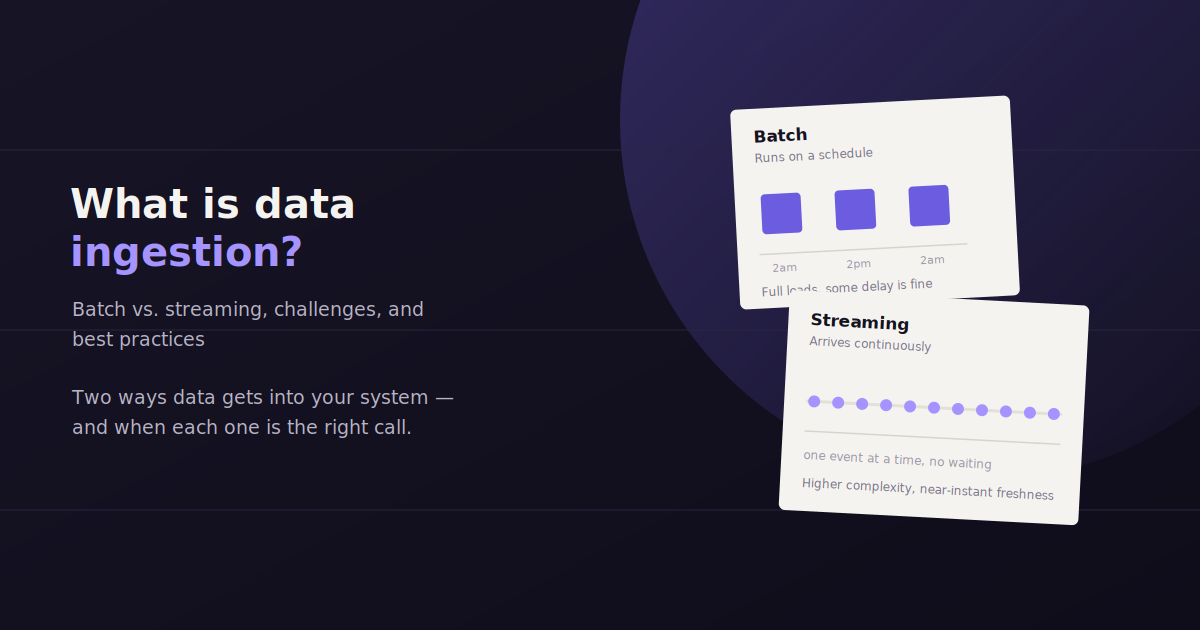
Batch ingestion collects data over a set period — hourly, daily, weekly — and moves it in one grouped transfer rather than continuously.
It’s the simpler and cheaper approach, and it’s more than sufficient for data that doesn’t need to be current to the minute, like a daily rollup of ad spend or a weekly export of CRM contacts.
The tradeoff is latency: if something changes right after a batch runs, you won’t see it reflected until the next scheduled batch.
Streaming Ingestion
Streaming ingestion moves data continuously, as events happen, rather than waiting for a scheduled window. A purchase, a click, a form submission each gets ingested individually and immediately.
It’s essential for use cases where a delay of even a few hours is a real problem — fraud detection, live inventory, or real-time personalization — but it costs more to build and run than batch ingestion.
Most marketing and reporting use cases don’t need true streaming. The extra infrastructure cost rarely pays for itself when a daily or hourly refresh would answer the same business question just as well.
Micro-Batch and Hybrid Approaches
Micro-batching splits the difference: data moves in small, frequent batches — every few minutes rather than every few hours — without the full complexity of a true streaming system.
Many marketing platforms and reporting tools actually run on micro-batch under the hood, which is why a dashboard can feel ‘close to real-time’ without the cost of a dedicated streaming pipeline.
Common Data Ingestion Challenges
Ingestion looks straightforward until you’re pulling from more than two or three sources at once. A few problems show up reliably once volume and source count grow.
Volume — large datasets can overwhelm a pipeline that wasn’t sized for them, slowing ingestion or causing timeouts during peak periods.
Velocity — sources that update at different speeds, like an hourly ad platform export next to a real-time webhook, complicate keeping downstream data consistent.
Variety — structured data from a database, semi-structured JSON from an API, and unstructured text from a log file all need different handling before they can sit in the same system.
Schema drift — a source platform renames or removes a field without warning, and an ingestion job built around the old schema can fail silently or drop data.
Rate limits and API changes — most marketing platforms cap how much data you can pull in a given window, and API versions get deprecated, both of which can break a pipeline that isn’t monitored.
Cost — storing and moving large volumes of raw data, especially at high frequency, adds up quickly if ingestion isn’t scoped to what’s actually needed downstream.
Push vs. Pull: Two Ways Data Actually Gets Ingested
Beyond batch and streaming, it helps to know the two mechanical patterns ingestion systems use to actually move data, since they show up inside both batch and streaming setups.
Pull-Based Ingestion
In a pull model, the destination system reaches out to the source on a schedule and requests data — calling an API every hour, for example, and asking for anything new since the last request.
This is the more common pattern for marketing data specifically, since most ad platforms, CRMs, and analytics tools expose an API built for exactly this kind of scheduled request.
Push-Based Ingestion
In a push model, the source system sends data to the destination as soon as it’s generated, usually through a webhook, without waiting to be asked.
It’s the more common pattern for event-level data — a form submission or a purchase confirmation triggering an immediate push — and it’s what makes near-real-time ingestion possible without constantly polling a source for updates.
How to Evaluate a Data Ingestion Tool
A good data ingestion tool combines broad native connector coverage, clear handling of schema changes and failures, predictable pricing as data volume grows, and enough scheduling flexibility to match how quickly each source actually needs to be current.
Connector coverage — check that the tool has a native, maintained connector for each of your actual sources rather than a generic API or CSV fallback that you’ll end up maintaining yourself.
Failure visibility — look for a tool that surfaces a broken connection or a schema mismatch clearly, rather than one that fails silently and leaves a gap in your data that goes unnoticed for weeks.
Scheduling flexibility — confirm you can set different refresh frequencies per source, since a daily ad spend pull and an hourly session count pull have very different needs.
Pricing that scales predictably — some ingestion tools price by data volume or row count, which can turn expensive fast once a campaign scales; confirm what happens to your bill at double your current data volume.
Destination compatibility — make sure the tool loads cleanly into wherever your data needs to end up, whether that’s a warehouse, a spreadsheet, or directly into a reporting tool.
How Data Ingestion Fits Into a Marketing or Analytics Pipeline
For a marketing team, ingestion usually means pulling data out of ad platforms, a website analytics tool, a CRM, and possibly email or social platforms, and landing it somewhere it can be combined.
Tools like Windsor.ai, Funnel.io, and Supermetrics specialize in this layer specifically for marketing data — they handle the connectors, authentication, and scheduling so a team doesn’t have to build custom ingestion jobs for every ad platform.
Once ingested, that data typically lands in a warehouse like Google BigQuery or a similar destination, where it gets modeled and made ready for reporting or analysis.
The quality of everything downstream — a dashboard, a report, an answer to a question — depends entirely on ingestion working correctly. A reporting tool built on top of broken or incomplete ingestion will confidently show you the wrong number.
Best Practices for Reliable Data Ingestion
Monitor for silent failures, not just crashes — a pipeline that runs successfully but pulls zero new rows is a more common failure mode than one that visibly errors out.
Version your source schemas so a field rename or removal upstream gets caught before it breaks a downstream report.
Separate raw and processed data — keep an unmodified copy of what was ingested so you can re-run transformations if a modeling mistake gets discovered later.
Match the ingestion frequency to the actual decision cycle — there’s little value in streaming data into a report someone only checks once a week.
Log ingestion metadata — timestamps, row counts, and source versions for every run make it dramatically faster to diagnose a broken pipeline months later.
Data Ingestion vs. Data Integration
These two terms get used almost interchangeably, but there’s a useful distinction once a team is choosing tools. Ingestion is about getting data into a system; integration is the broader practice of making systems work together, which includes ingestion but also covers syncing data back out, keeping records reconciled across platforms, and triggering actions in one system based on data from another.
In practice, most marketing teams only need ingestion, not full bidirectional integration. You’re pulling reporting data in to analyze it, not pushing changes back out to the ad platform or CRM in real time. Understanding which one you actually need keeps you from paying for integration features — two-way sync, workflow automation, write-back — that a reporting use case never touches.
Where Conversational AI Tools Fit In
Ingestion, modeling, and reporting are three separate layers, and it’s worth being clear about which one a given tool actually handles.
Conversational tools like ConvoData sit at the reporting layer — they connect to your data sources, and once the data is flowing in, you can ask a plain-English question and get a live answer plus a suggested next step, instead of writing a query or building a dashboard.
That’s a different job than ingestion. ConvoData depends on your data sources being connected and updating reliably; it doesn’t replace the need for a sound ingestion setup underneath it, but it does remove a lot of the manual work that used to sit between ‘the data arrived’ and ‘someone can actually use it.’
Once data is flowing in, the next question is usually how to structure it for reporting — see our guide to ETL and data mapping for that step, and our piece on building a marketing data warehouse for where it all eventually lands.
Frequently Asked Questions
What is the difference between data ingestion and ETL?
Data ingestion is the process of collecting and moving data into a system; ETL (extract, transform, load) includes ingestion as its first step but also covers transforming and structuring the data afterward. Ingestion is really the E and initial L; ETL is the full pipeline.
Is batch or streaming ingestion better?
Neither is universally better — batch is cheaper and simpler and fits most reporting use cases, while streaming is worth the added cost only when a delay of minutes or hours would genuinely cause a problem, like fraud detection or live inventory.
What are examples of data ingestion tools?
Marketing-focused examples include Windsor.ai, Funnel.io, and Supermetrics, which handle connectors and scheduling for pulling data out of ad platforms and other marketing sources into a warehouse or reporting tool.
What causes most data ingestion failures?
Schema drift, where a source platform changes a field without warning, and API rate limits or deprecations are two of the most common causes, along with pipelines that weren't monitored closely enough to catch a silent drop in data volume.
Do I need real-time data ingestion for marketing reporting?
Rarely. Most marketing decisions are made on a daily or weekly cycle, so batch or micro-batch ingestion usually delivers data fast enough — true streaming adds cost that's hard to justify unless you need minute-by-minute accuracy.
How does data ingestion relate to data warehousing?
Ingestion is how data gets into the warehouse in the first place. Once ingested, the warehouse is where that data gets stored, modeled, and made available for reporting tools or direct querying.
Once your data is ingested and flowing reliably, the next bottleneck is usually turning it into an answer someone can act on — that’s the gap ConvoData is built to close, letting you ask plain-English questions against your connected sources starting at $39/month.