


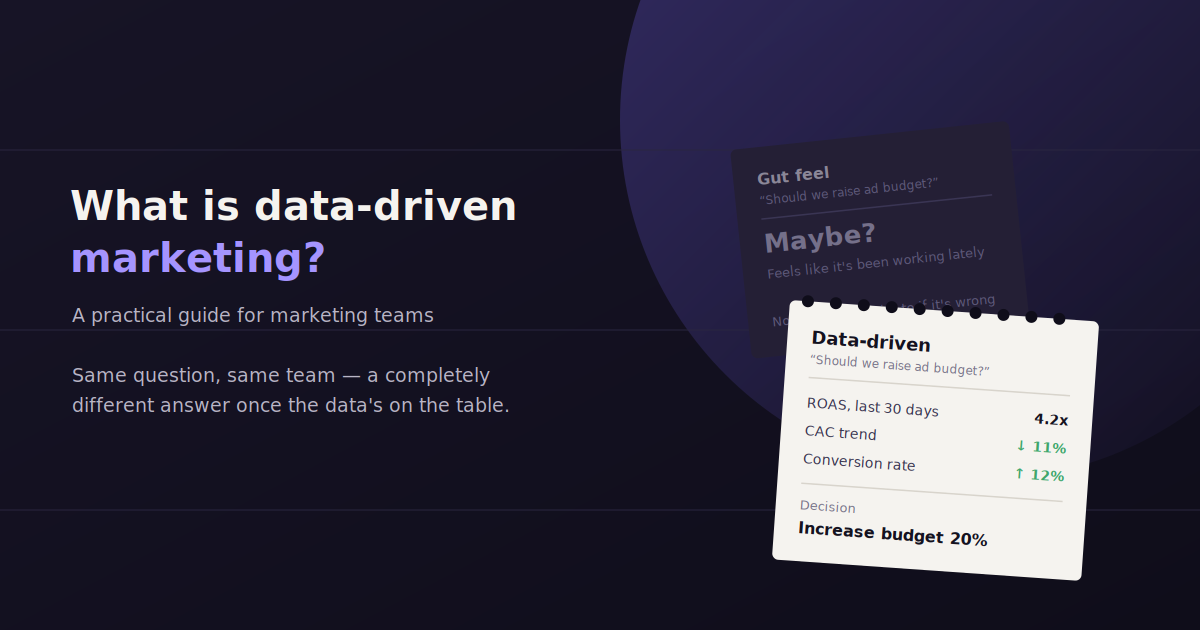
Data-driven marketing is the practice of shaping campaigns, budgets, and messaging around evidence pulled from customer and performance data, instead of relying on assumptions about what an audience wants.
It sounds obvious stated that way, yet most teams still make real decisions off a gut feeling, a competitor’s move, or whatever channel got attention last quarter — not because the data doesn’t exist, but because pulling it together takes more time than the decision seems to deserve.
This guide covers what data-driven marketing actually means in practice, how it differs from the traditional approach, the types of data that feed it, and a straightforward process for building a data-driven strategy without a dedicated analytics team.
We’ll also cover where conversational tools like ConvoData fit into this picture — not as a replacement for strategy, but as a way to get answers out of your data faster than a manual pull allows.
What Is Data-Driven Marketing, Exactly?
Data-driven marketing means using measurable evidence — website behavior, campaign performance, purchase history, and customer feedback — to guide marketing decisions instead of intuition or industry convention, and adjusting based on what the data shows as campaigns run.
At its core, data-driven marketing means every meaningful decision — which audience to target, which channel to prioritize, which message to lead with — is backed by evidence you can point to, not a hunch.
That evidence usually comes from a mix of sources: website analytics, ad platform performance, CRM records, email engagement, and direct customer feedback. None of these on their own tells the full story, which is part of why data-driven marketing is as much about connecting sources as collecting them.
The other defining trait is that it’s ongoing, not a one-time setup. A data-driven team keeps checking what’s actually happening against what they expected and adjusts mid-campaign, rather than waiting for a quarterly review to notice something isn’t working.
Data-Driven Marketing vs. Traditional Marketing
Traditional marketing leans on broad assumptions about an audience — demographic profiles, industry best practices, past campaigns that worked reasonably well. It’s not wrong, exactly, but it treats every customer in a segment as roughly interchangeable.
Data-driven marketing replaces those assumptions with specifics: which pages this visitor viewed before converting, which subject line this segment actually opens, which channel is producing customers who stick around versus ones who churn in month two.
Targeting: Traditional marketing segments broadly by demographics; data-driven marketing segments by observed behavior and intent signals.
Measurement: Traditional campaigns are often judged on reach or impressions; data-driven campaigns are judged on downstream outcomes like cost per acquisition and retention.
Timing: Traditional marketing reviews results after a campaign ends; data-driven marketing checks performance while a campaign is still running and adjusts it.
Personalization: Traditional marketing sends the same message to an entire segment; data-driven marketing tailors messaging to individual behavior where the data supports it.
Budget allocation: Traditional marketing splits spend based on historical convention; data-driven marketing shifts spend toward whatever channel is currently converting best.
The Types of Data That Power a Data-Driven Strategy
Data-driven marketing typically draws on five categories: first-party behavioral data, transactional data, engagement data, demographic data, and third-party or intent data — combined, they show not just who a customer is but what they’re actually doing.
Not all data carries the same weight. A useful strategy usually combines several categories rather than leaning on just one.
Behavioral data — page views, time on site, scroll depth, and click paths captured through tools like Google Analytics, showing what a visitor actually does rather than what they say they want.
Transactional data — purchase history, order value, and repeat purchase frequency, usually pulled from a CRM or ecommerce platform.
Engagement data — email open and click rates, social interactions, and ad engagement, which show which messages and formats resonate.
Demographic and firmographic data — age, location, job title, or company size, useful for segmentation but weaker on its own than behavioral signals.
Third-party and intent data — signals from outside your own systems, like search trends or industry benchmarks, that add context you can’t observe directly.
How to Build a Data-Driven Marketing Strategy: A 6-Step Process
Building a data-driven strategy means defining clear goals, auditing your current data sources, consolidating them into one place, setting measurable KPIs, running and monitoring campaigns against those KPIs, and reviewing results on a fixed cadence to adjust the next cycle.
1. Define What You’re Actually Trying to Learn
Before touching any data, write down the specific question your strategy needs to answer — not “grow revenue,” but something closer to “which acquisition channel produces customers with the highest 90-day retention.”
A vague goal produces a vague data pull. A specific question tells you exactly which data sources matter and which you can ignore for now.
2. Audit Your Current Data Sources
List every place customer and performance data currently lives — analytics platforms, ad accounts, your CRM, email tool, and any spreadsheets someone maintains by hand.
Most teams find this list is longer and messier than expected, with the same customer represented differently across two or three systems.
3. Consolidate Data Into One Place
Scattered data is the single biggest blocker to acting on it quickly. Bringing your key sources into one dashboard, warehouse, or connected tool means you’re not stitching together three exports every time a question comes up.
This doesn’t have to mean a full data warehouse build for a small team — even a shared dashboard that pulls live from your main platforms is a meaningful upgrade from manual exports.
4. Set Measurable KPIs Tied to the Original Question
Pick two or three KPIs that directly answer the question you defined in step one, and resist the urge to track everything just because it’s available.
A KPI that doesn’t change how you’d act on the answer isn’t worth the dashboard space.
5. Run Campaigns and Monitor in Real Time
Launch the campaign, but don’t wait until it ends to look at the numbers. Check performance against your KPIs early enough to shift budget or messaging while the campaign can still benefit.
This is where the gap between traditional and data-driven marketing shows up most clearly — the willingness to adjust mid-flight instead of only debriefing afterward.
6. Review, Document, and Adjust the Next Cycle
After the campaign ends, compare actual results to your original KPIs and write down what worked, what didn’t, and why — in plain language a teammate could act on without re-running the analysis.
Feed that into the next planning cycle. Data-driven marketing compounds; each cycle should start from a slightly better baseline than the last.
Metrics That Matter in Data-Driven Marketing
Different goals call for different metrics, but a few show up across nearly every data-driven strategy because they measure outcomes rather than activity.
| Metric | What It Tells You |
|---|---|
| Customer Acquisition Cost (CAC) | How much you’re spending, on average, to win one new customer |
| Customer Lifetime Value (CLV) | How much revenue a customer generates over the full relationship, not just the first purchase |
| Conversion Rate | The percentage of visitors or leads who complete a defined action |
| Channel Attribution | Which touchpoints actually contributed to a conversion, not just the last click |
| Retention Rate | How many customers stick around after their first purchase or signup |
| Return on Ad Spend (ROAS) | Revenue generated per dollar spent on a given campaign or channel |
Common Mistakes That Undermine Data-Driven Marketing
Adopting data-driven marketing in name is easy. Doing it well takes avoiding a handful of recurring mistakes.
Collecting data without a question in mind. Dashboards full of metrics nobody asked for don’t drive better decisions; they just add noise to sift through.
Treating correlation as causation. A spike in conversions during a campaign doesn’t prove the campaign caused it — check for seasonality, other concurrent changes, or simple coincidence first.
Letting data live in silos. If your ad platform, CRM, and analytics tool never talk to each other, every analysis starts with an hour of manual reconciliation before the actual thinking begins.
Over-personalizing on thin data. Personalizing based on a single data point (like one past purchase) can feel presumptuous or simply wrong if that data point was a gift or a one-off.
Ignoring data quality. Duplicate records, outdated email lists, and mismatched customer IDs quietly erode every calculation built on top of them.
Examples of Data-Driven Marketing in Action
The concept is easier to picture with a few concrete examples of how teams actually apply it day to day.
Retargeting based on site behavior. A visitor who viewed a pricing page but didn’t convert gets a different retargeting ad than one who only viewed a blog post — the behavior data determines the message, not a generic segment.
Dynamic email content. Instead of one newsletter for the whole list, email content blocks change based on past purchase category or engagement level, pulled directly from CRM and behavioral data.
Lookalike audience targeting. Ad platforms build new audiences that resemble your highest-value existing customers, using conversion and purchase data as the seed rather than broad demographic guesses.
Send-time optimization. Email and push notifications go out at the time each individual recipient historically engages, rather than one fixed send time for the entire list.
Budget reallocation mid-campaign. A team notices, three days into a campaign, that one ad set is producing leads at half the cost of another, and shifts budget accordingly instead of waiting for the campaign to end.
Building a Data-Driven Culture on Your Team
Tools and dashboards only go so far if the team’s default instinct is still to guess first and check the data later, if at all.
The shift usually starts small: making it normal to ask “what does the data say” in a planning meeting, and treating that question as routine rather than confrontational.
It also means being honest when the data contradicts a favorite idea. A data-driven culture only holds up if leadership is willing to kill a campaign or a creative direction the data doesn’t support, even when it was someone’s pet project.
Finally, keep the feedback loop short. A monthly report that arrives three weeks after a campaign ends teaches the team much less than a weekly check-in while the campaign is still adjustable.
Where Conversational AI Tools Fit Into a Data-Driven Strategy
Even a well-consolidated data setup still requires someone to actually query it — filtering a dashboard, exporting a report, or writing a spreadsheet formula every time a new question comes up.
Conversational tools like ConvoData sit on top of your connected marketing data sources and remove that manual step: you ask a plain-English question, like which campaign drove the lowest cost per lead last month, and get a live answer pulled directly from the data, along with a suggested next step.
That’s a meaningful shift from a static dashboard, which shows you numbers but leaves the interpretation and the next move entirely up to you. ConvoData currently connects to 14 live data sources out of a 27-integration roadmap, with more shipping regularly, so it’s worth checking whether your specific stack is covered.
It doesn’t replace the strategy work of defining the right question in the first place — that judgment still belongs to your team. What it removes is the friction between having a question and getting an answer, which is often where data-driven marketing quietly stalls.
None of this works without a solid data foundation — see our guide to building a marketing data warehouse for where that data should live. And once you are making decisions off the data, our guide to KPI analytics covers how to choose which numbers should actually drive them.
Frequently Asked Questions
What is data-driven marketing in simple terms?
It's the practice of making marketing decisions — targeting, budget, messaging — based on measurable data about customer behavior and campaign performance, rather than assumptions or industry convention, and adjusting continuously as new data comes in.
What are the main benefits of data-driven marketing?
It typically leads to more accurate targeting, better budget allocation toward what's actually working, faster identification of underperforming campaigns, and messaging that reflects real customer behavior instead of guesswork.
What data sources are most important for data-driven marketing?
Behavioral data (like website analytics), transactional data (purchase history), and engagement data (email and ad interactions) tend to matter most, since they reflect what customers actually do rather than who they are demographically.
Do small businesses need a data team to be data-driven?
No — a small team can practice data-driven marketing with a consolidated dashboard and a few clearly defined KPIs. A dedicated data or analytics team becomes more valuable as data sources and campaign volume grow.
How often should marketing data be reviewed?
Active campaigns benefit from checking performance weekly or even more often against defined KPIs, while broader strategy reviews — channel mix, budget allocation, positioning — are typically done monthly or quarterly.
If your team already collects the right marketing data but still spends hours pulling it together before you can answer a simple question, that’s exactly the gap ConvoData is built to close — connect your data sources and start asking questions in plain English, starting at $39/month.