


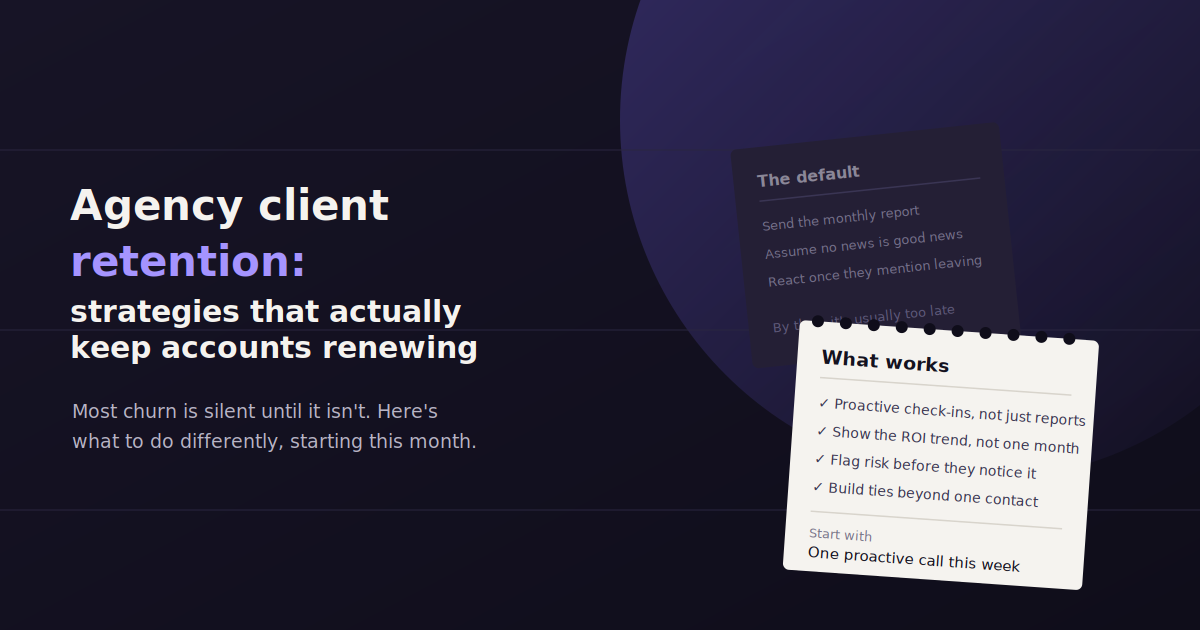
Winning a new client costs an agency far more than keeping one, yet most agency growth plans still lean almost entirely on new business.
Agency client retention is the quieter growth lever — a five-point improvement in retention compounds into meaningfully higher lifetime revenue per account without adding a single new logo.
Most churn doesn’t happen because of a single bad month. It builds slowly, through missed expectations, thin communication, and a client who stops seeing clear evidence that the work is paying off.
This guide covers why agency clients actually leave, the metrics worth tracking, and the specific habits — from onboarding through reporting — that keep accounts renewing year after year.
Why Client Retention Matters More Than New Business
Retaining an existing agency client is significantly cheaper than acquiring a new one, and small gains in retention compound over time into much higher account lifetime value — making retention the highest-leverage growth lever most agencies underinvest in.
New business requires pitching, proposal writing, and a ramp-up period before a client account becomes profitable. Retained clients skip all of that and go straight to margin.
Retention also protects an agency’s reputation. A client who churns after three months talks about that experience in industry circles far more than a happy five-year client ever mentions their agency by name.
Every account manager’s calendar makes this tradeoff daily, whether they realize it or not: time spent shoring up an at-risk account is almost always a better return than time spent chasing a colder lead.
The Top Reasons Agency Clients Actually Churn
Pricing is rarely the real reason a client leaves, even when it’s the reason stated in the exit conversation. Most churn traces back to a slower erosion of trust that pricing becomes an easy excuse to act on.
The most common root cause is a mismatch between what a client expected and what they experienced — often because expectations were set loosely during the sales process and never revisited.
Unclear ROI — the client can’t tell whether the retainer is actually moving the numbers that matter to their business.
Inconsistent communication — weeks pass with no update, so the client assumes nothing is happening.
Account manager turnover — a new point of contact resets trust and forces the client to re-explain context repeatedly.
Reporting that raises more questions than it answers — a dashboard full of metrics without any explanation of what changed or why.
Scope creep without renegotiation — the client keeps asking for more, the agency keeps saying yes, and margins quietly disappear.
Agency Client Retention Metrics Worth Tracking
The core agency client retention metrics are client retention rate, net revenue retention, average account tenure, and Net Promoter Score — tracked quarterly, they surface at-risk accounts months before a client actually gives notice.
Retention rate alone is a lagging indicator — by the time it drops, you’ve already lost the client. Net revenue retention and NPS tend to move earlier and give more warning.
Time-to-first-value deserves more attention than most agencies give it. Clients who see a measurable win in the first 90 days renew at meaningfully higher rates than those who don’t.
| Metric | What It Measures | Healthy Benchmark |
|---|---|---|
| Client Retention Rate | % of clients still active after 12 months | 80%+ for most agency models |
| Net Revenue Retention | Revenue from existing clients, including upsells minus churn | 100%+ (growth from existing base) |
| Average Account Tenure | Average length of an active client relationship | 18+ months |
| Client NPS | Likelihood a client would recommend the agency | 30+ is strong for B2B services |
| Time-to-First-Value | How long until a client sees a measurable result | Under 90 days |
Building a Retention-Focused Onboarding Process
Retention starts before the first deliverable ships. A rushed onboarding sets vague expectations that come back to bite the relationship six months later.
The strongest onboarding processes align on three things explicitly, in writing, before any work begins: what success looks like, how often the client will hear from the agency, and what data the agency needs access to.
Set Explicit Success Metrics Early
Ask the client directly what number they’re watching internally — leads, revenue, app installs — and make sure it’s the same number the agency reports on.
A mismatch here is one of the most common, and most avoidable, causes of a client feeling like the agency is optimizing for the wrong thing.
Agree on a Communication Cadence Upfront
Weekly check-ins suit fast-moving PPC accounts; monthly suits slower SEO or brand work. Set the cadence explicitly rather than letting it drift based on whoever remembers to schedule the call.
Put it in the onboarding document. A client who knows exactly when they’ll hear from you rarely feels like they’re being ignored, even during a quiet stretch.
The Role of Reporting in Client Retention
Reporting drives agency client retention when it explains why a number moved and what happens next, not just what the number is — a report that only displays data leaves the client to interpret results alone, which is where trust erodes fastest.
A monthly PDF full of charts satisfies a contractual obligation. It rarely satisfies a client who’s trying to understand whether the retainer is working.
The gap is almost always explanation. Clients don’t churn because a metric dropped — they churn because nobody told them why it dropped or what the agency is doing about it.
This is where a growing number of agencies are shifting from static dashboards toward tools that answer questions directly. ConvoData, for instance, lets an account manager type a plain-English question — “why did this client’s conversion rate drop last month” — and get a live answer pulled from the connected data, plus a suggested next step to bring into the next client call.
That shift matters for retention specifically because it changes what a check-in call sounds like. Instead of reading numbers off a slide, an account manager walks in with an answer already prepared.
Communication Habits That Keep Clients Engaged Between Reports
Monthly reports alone leave a lot of silence in between. Clients fill that silence with assumptions, and the assumption is rarely “everything is going great and nobody needs to tell me.”
A short weekly or biweekly note — even three sentences — closes that gap without requiring a full report cycle.
A one-line Slack or email update on anything notable, even a small win, between full reporting cycles.
Proactive flags on bad news — a client should never hear about a performance dip from their own dashboard before hearing it from the agency.
A quarterly strategy check-in separate from the routine reporting call, focused on direction rather than last month’s numbers.
Clear escalation paths so a client knows exactly who to contact when something feels off, instead of guessing.
Warning Signs a Client Is About to Churn
Churn rarely arrives without warning. The signs are usually visible weeks or months ahead, but easy to miss without a deliberate process for tracking account health.
The most reliable early signal is engagement, not performance. A client whose numbers dip but who’s still actively asking questions and joining calls is far less likely to leave than one whose numbers are fine but who’s gone quiet.
Slower response times to emails or scheduling requests that used to get a same-day reply.
Fewer questions on calls — engaged clients push back and ask why; disengaged clients just nod along.
Requests for raw data exports without a stated reason, which sometimes signals a client building a case to compare agencies.
A new stakeholder joining calls who wasn’t part of the original relationship and doesn’t share the same context or trust.
How to Win Back an At-Risk Client
The instinct when a client seems unhappy is to work harder and say less, hoping better results will speak for themselves. That instinct is usually wrong.
The better move is a direct, structured conversation: acknowledge what hasn’t gone well, lay out a specific plan with dates attached, and follow up on that plan visibly rather than quietly.
Clients who are seriously considering leaving respond better to a agency that names the problem first than one that waits to be confronted about it.
Pricing and Contract Structures That Support Retention
Retention isn’t only about service quality — contract structure plays a real role too. Month-to-month agreements with no minimum commitment tend to churn faster simply because leaving carries no friction.
Longer initial terms, paired with a clear performance review built into the contract, give both sides a reason to work through a rough patch instead of one side quietly exiting.
Scope clarity matters just as much as term length. A retainer with a loosely defined scope invites the exact kind of creeping expectations that erode margin and, eventually, the relationship itself.
Define scope explicitly in the contract, including what counts as a change request versus what’s already included.
Build in a quarterly review clause so both sides have a structured moment to renegotiate rather than letting frustration build silently.
Avoid pure month-to-month terms where possible — even a 90-day minimum reduces impulsive churn during a single rough month.
Price for the actual workload, not a discounted rate to win the deal — underpriced accounts breed resentment on the agency side that eventually shows up in service quality.
Training Account Managers to Own Retention
Retention is often treated as a leadership responsibility that only becomes visible once a client is already unhappy. In the strongest agencies, it’s a frontline account manager responsibility from day one.
That means giving account managers real ownership over account health — not just delivery — including the authority to flag a struggling account internally before it becomes a crisis.
It also means training account managers to have the uncomfortable conversation early. Waiting for a client to bring up dissatisfaction almost always means the agency is already behind.
Retention and reporting go hand in hand — see our 10 agency reporting tips that actually improve retention for tactics that pair directly with the strategies here, and our guide to the agency metrics and KPIs every owner should track for what to measure to know if retention is actually improving.
Frequently Asked Questions
What is a good client retention rate for a marketing agency?
Most healthy agencies retain 80% or more of their clients over a 12-month period, though the right benchmark varies by service type — project-based work naturally churns faster than ongoing retainer relationships.
How do you measure agency client retention?
The core formula divides clients retained over a period by clients at the start of that period, excluding new clients acquired during it. Pair that rate with net revenue retention and NPS for a fuller picture of account health.
Why do agency clients leave even when results are good?
Often because they can't clearly see or understand the results, not because the results are actually poor. Unclear reporting and inconsistent communication erode trust even on accounts that are technically performing well.
How often should an agency communicate with clients to improve retention?
A full report monthly is standard, but a short update between cycles — weekly or biweekly — keeps clients from filling silence with assumptions and meaningfully improves engagement and retention.
What role does reporting play in reducing agency churn?
Reporting that explains why a metric moved and what happens next builds far more trust than reporting that only displays numbers. Clients rarely churn over a dip in performance alone — they churn when they don't understand it.
What are the earliest warning signs a client might churn?
Slower email responses, fewer questions on calls, and a drop in overall engagement typically show up weeks before a client formally gives notice — well before their actual performance metrics decline.
Does contract length affect agency client retention?
Yes — month-to-month contracts with no minimum term tend to churn faster because there's no friction to leaving. A defined initial term paired with a structured quarterly review tends to support longer relationships.
Who should be responsible for client retention at an agency?
Account managers should own retention as part of daily account health, not just delivery, with the authority to flag a struggling account internally before it escalates. Leadership should support that process, not be the first line of defense.
If your reporting process leaves clients guessing why a number moved, close that gap directly. Connect your accounts to ConvoData and start answering the questions clients actually ask — plans start at $39/month.