


Reach and impressions get used interchangeably in casual conversation, but they measure genuinely different things — and mixing them up leads to bad budget decisions.
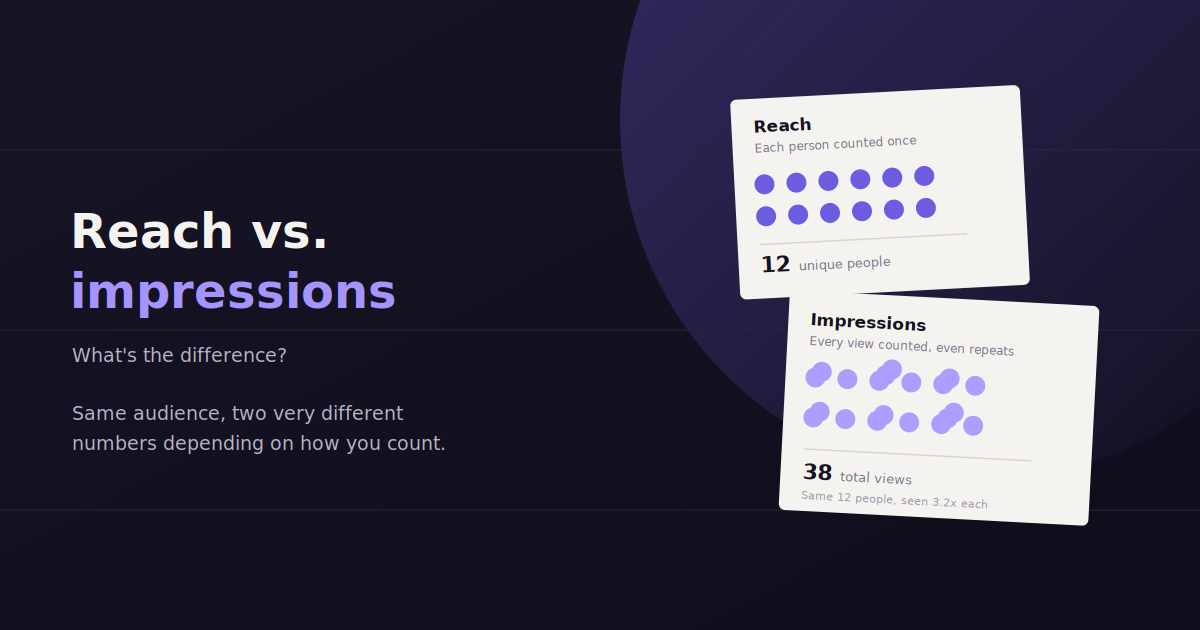
Reach is how many unique people saw your content. Impressions is how many times it was displayed, including repeat views by the same person.
One person scrolling past your ad three times counts as 3 impressions but only 1 reach — a distinction that matters more than it sounds once you’re setting campaign goals.
This guide breaks down both metrics, how they differ across platforms, and when to prioritize one over the other.
What Is Reach?
Reach is the total number of unique users who have seen your content or ad at least once, regardless of how many times each person viewed it. It answers the question: how many different people did this actually get in front of?
Reach caps out at your total available audience — you can’t reach more people than exist in your targeting pool, no matter how much you spend.
It’s the metric to prioritize when the goal is awareness: getting a message in front of as many distinct people as possible, even if each only sees it once.
What Are Impressions?
Impressions count the total number of times your content was displayed on a screen, including every repeat view by the same person. Unlike reach, impressions have no ceiling — they keep climbing as long as your ad keeps showing.
A high impressions count with flat reach means you’re showing the same content to the same people repeatedly rather than expanding your audience.
Impressions matter most for frequency-sensitive goals, like reinforcing a message enough times to drive recall or action from an already-identified audience.
The Core Distinction, With an Example
Say your page has 500 followers and you publish a post. Not everyone sees it immediately, or at all — the actual reach might be 200 people.
If 50 of those 200 people scroll past it twice (in their feed and again in a shared post), your impressions climb to roughly 250, while reach stays at 200.
This is why a viral-looking impressions number can mask a much smaller actual audience — always check reach before assuming impressions represent unique interest.
How Reach and Impressions Differ by Platform
Google Ads and Analytics don’t use “reach” as a native term the way social platforms do — impressions is the default ad-view metric, and unique reach is typically approximated through unique users or audience reports instead.
Because definitions shift slightly platform to platform, always confirm what a specific dashboard is counting before comparing numbers across channels.
| Platform | How Reach Is Defined | Notes |
|---|---|---|
| Unique accounts that saw a post or ad | Organic and paid reach are tracked separately | |
| Unique accounts reached, similar to Facebook | Story views counted distinctly from feed reach | |
| Twitter (X) | Unique accounts that saw a Tweet | Impressions often reported more prominently than reach |
| Google Ads / Analytics | Often approximated via unique users or sessions | “Impressions” is the platform’s default term for ad views |
How to Measure Reach and Impressions Without Confusion
Most native platform analytics — Meta Business Suite, X Analytics, Google Ads — report both metrics directly, so the raw numbers are usually available without extra tools.
The harder part is comparing them consistently across channels in one report, since each platform’s dashboard formats and definitions differ slightly.
A conversational tool like ConvoData can pull both figures from your connected accounts and answer a direct comparison question — like whether last month’s reach grew faster than impressions — without you reconciling spreadsheets from three different platforms by hand.
Common Mistakes When Interpreting Reach and Impressions
The most common mistake is treating impressions as a proxy for audience size — a campaign with 50,000 impressions might have only reached 8,000 unique people if frequency is high.
The second is comparing reach numbers across platforms without accounting for definitional differences — a platform that reports “potential reach” (total addressable audience) is measuring something different from “actual reach” (people who genuinely saw the content).
The third is ignoring reach entirely in favor of impressions because impressions numbers look bigger — a report that leads with the larger number without context can overstate a campaign’s actual audience impact.
Reach vs Impressions in Organic vs Paid Content
Organic reach is capped by the platform’s algorithm and your existing audience — it tends to be smaller and harder to grow predictably.
Paid reach can be purchased and scaled directly through budget, which is why paid campaigns typically report both reach and impressions prominently, while organic posts often only surface impressions by default.
Understanding which type of reach you’re looking at matters when setting expectations — a paid campaign’s reach ceiling is your budget and targeting; an organic post’s reach ceiling is algorithmic distribution and existing follower engagement.
How to Calculate Frequency — and What It’s Telling You
Frequency is impressions divided by reach. It’s the single number that turns two raw counts into an actual read on whether a campaign is expanding its audience or just repeating itself.
A campaign with 40,000 impressions and 20,000 reach has a frequency of 2 — the average person saw it twice. That’s healthy for most awareness campaigns. The same 40,000 impressions against 5,000 reach gives a frequency of 8, which usually means the audience is too narrow for the budget being spent against it.
There’s no universal “good” frequency number — it depends entirely on the goal, the length of the sales cycle, and how much the creative varies within the campaign. A retargeting campaign chasing a purchase decision might need a frequency of 5-7 to drive action, especially for a considered purchase with a longer decision window. A cold-audience awareness campaign starts losing efficiency well before that, often somewhere between 3 and 4, because each additional impression to the same person delivers less incremental value than the first two did.
The practical use of frequency is as an early-warning signal: track it weekly, and when it climbs while reach stays flat, that’s the campaign telling you the targeting pool is exhausted before the budget is.
How Ad Fatigue Shows Up in the Numbers
Ad fatigue is what happens when frequency climbs past the point of usefulness — the audience has seen the creative enough times that engagement drops even though spend keeps flowing.
CTR declines while frequency rises. The same people seeing the same creative repeatedly click less each time — this is usually the first visible signal.
CPM creeps up even with stable targeting. Platforms interpret falling engagement as a relevance signal and charge more to keep delivering to the same audience.
Negative feedback increases. “Hide ad” or similar actions tend to rise alongside frequency on social platforms, which further hurts delivery.
The fix is rarely more budget. Refreshing creative or expanding the audience pool addresses fatigue directly; increasing spend on a fatigued audience usually just accelerates the frequency climb.
Reach and Impressions vs. Engagement: Where Engagement Fits
Reach and impressions describe exposure — how many people saw something and how many times. Engagement (likes, comments, shares, clicks) describes reaction — what people did after seeing it. A campaign can post strong reach and impressions numbers while engagement stays flat, which usually means the content got in front of people without resonating.
The three metrics work best read together rather than separately. High reach with low engagement suggests a targeting or creative mismatch — the right volume of people saw it, but it didn’t land. Low reach with high engagement rate suggests the opposite problem: content that’s working is just not getting distributed to enough people, which is often a budget or algorithm distribution issue rather than a creative one.
Engagement rate is typically calculated against either reach or impressions, and which denominator a platform uses changes the number meaningfully — always check which one a dashboard is using before comparing engagement rates across platforms or campaigns.
Setting Realistic Reach Goals by Audience Size
A reach target only means something in relation to the addressable audience behind it. Reaching 10,000 people from a targeting pool of 50,000 (20%) is a strong result; reaching the same 10,000 from a pool of 2 million (0.5%) usually signals a budget or bidding problem, not a ceiling on interest.
For organic content, realistic reach is typically a fraction of total followers — algorithmic distribution on most platforms shows organic posts to somewhere between 5% and 20% of followers, which is why a page with 10,000 followers seeing 800 organic reach on a post isn’t necessarily underperforming.
For paid campaigns, reach scales with budget up to the size of the targeting pool, so the more useful benchmark is cost per unique person reached (total spend divided by reach) tracked over time — a rising cost per reach at flat budget usually means the audience is saturating.
Which Metric Should You Prioritize?
Prioritize reach when your goal is audience growth or broad awareness — you want as many unique people as possible seeing your message. Prioritize impressions (and frequency) when your goal is message reinforcement to an already-identified audience.
New product launch or brand awareness: prioritize reach — you want breadth over repetition.
Retargeting a warm audience: prioritize frequency (impressions relative to reach) — repetition drives recall and action.
Budget efficiency check: watch both together — rising impressions with flat reach signals it may be time to expand targeting.
Impressions specifically come with their own reporting nuances worth understanding on their own — see our guide to what impressions mean and how to report them. Once you are comfortable with both metrics, our broader guide to KPIs for advertising covers where reach, impressions, and frequency fit into a fuller paid media KPI set.
Frequently Asked Questions
Can impressions be lower than reach?
No — impressions is always equal to or greater than reach, since every unique person counted in reach contributes at least one impression.
What is frequency in advertising?
Frequency is impressions divided by reach — the average number of times each unique person saw your content. High frequency in a short window often signals ad fatigue.
Which metric matters more for a small budget?
Reach generally matters more for small budgets, since spreading limited spend across as many unique people as possible tends to outperform repeatedly showing the same few people an ad.
Do reach and impressions cost the same to buy?
No — CPM (cost per 1,000 impressions) is the standard buying unit on most platforms, so campaigns optimized for reach are still typically billed against impressions delivered.
What's a good frequency before ad fatigue sets in?
For cold-audience awareness campaigns, engagement often starts declining somewhere around a frequency of 3 to 4. Retargeting campaigns can typically sustain higher frequency, sometimes 5 to 7, before the same drop-off appears — the right number depends on the audience and creative, so watching the trend matters more than hitting a fixed target.
Why does my impressions count keep rising while reach stays flat?
This means the same group of people is seeing your content repeatedly rather than the campaign expanding to new people. It's normal for a short retargeting push, but for an awareness campaign it usually signals the targeting pool needs to be widened or the budget is outpacing the available audience.
Is reach or impressions the better metric for a media kit or sponsorship pitch?
Reach is the more honest number for a sponsorship pitch, since it reflects actual unique audience size rather than inflated repeat views. Brands evaluating a partnership are typically trying to estimate how many distinct people they'd get in front of, which is what reach measures directly.
Can reach go down while impressions go up?
Yes, and it's a specific warning sign rather than a contradiction. It means the platform is showing your content more often to a shrinking pool of people — usually because the audience is fatiguing, the targeting has narrowed, or delivery is being throttled to a smaller responsive segment. It's worth investigating rather than reading as growth.
Pull your last campaign’s reach and impressions side by side and check the frequency — if it’s climbing fast, ask ConvoData whether it’s time to expand your audience. Plans start at $39/month.