


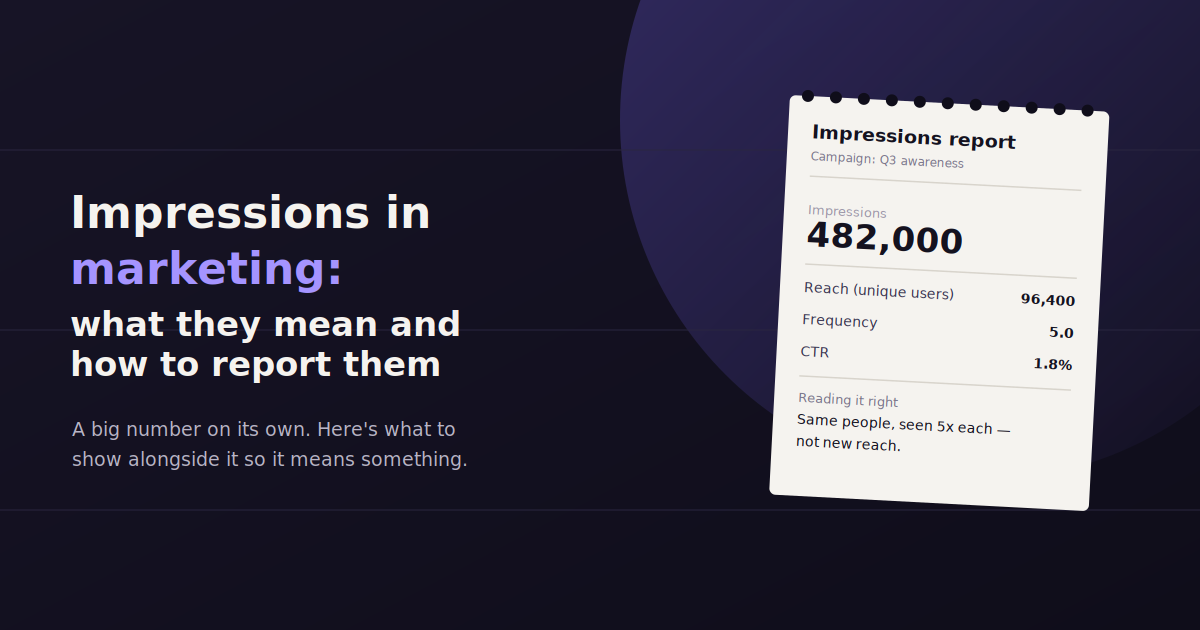
An impression is counted every time an ad or piece of content loads on a screen where someone could see it. It doesn’t mean a person read it, clicked it, or even noticed it — it means the content was served.
That distinction trips up a lot of client conversations. A campaign with 500,000 impressions sounds impressive on a slide, but the number alone says nothing about whether it moved anyone toward a purchase.
This guide breaks down what impressions actually measure, how they’re counted differently across Google Ads, Meta, and programmatic display, and how to pair them with metrics that show real performance — so you can report on impressions without overselling them.
Tools like ConvoData pull impressions alongside CTR, CPM, and conversion data from your connected ad accounts automatically, which makes it easier to keep the metric in context instead of reporting it in isolation.
What Is an Impression in Marketing?
An impression is a single instance of an ad or piece of content being displayed on a screen, regardless of whether anyone looked at it, clicked it, or engaged with it. It’s a delivery metric, not an engagement metric.
Every major ad platform defines an impression the same basic way: one load, one count. If the same person refreshes a page three times and your ad loads each time, that’s three impressions — not three interested people.
Impressions exist to measure delivery, not response. They answer “did my content get served to someone’s screen,” which is a useful question, but a narrower one than most people assume when they see a big impressions number.
This is why impressions sit at the very top of the marketing funnel. They’re a prerequisite for everything else — clicks, conversions, revenue — but they don’t guarantee any of it happens.
Ad impressions: counted when a paid ad (search, display, social, video) is served and rendered on a user’s screen.
Social impressions: counted when a post, story, or reel appears in someone’s feed, whether organic or boosted.
Page impressions / pageviews: sometimes used loosely to mean a page load, though this is closer to a pageview metric than a true ad impression.
Impressions vs. Reach, Clicks, and Views
Impressions count total ad displays, including repeats to the same person. Reach counts unique people who saw it at least once. Clicks and views measure actual interaction, which is why impressions alone can’t tell you if a campaign worked.
These four terms get mixed up constantly in client meetings, and the mix-up leads to real confusion about what a campaign accomplished.
Impressions and reach are the pair people confuse most often. Impressions count every display, including repeat views to the same person. Reach counts only unique people reached at least once. A campaign with 100,000 impressions might have reached just 20,000 unique people — an average frequency of 5 views per person.
Impressions vs. Reach
If impressions are far higher than reach, your campaign is showing the same ad to the same people repeatedly rather than expanding to new audiences. That’s not automatically bad — repetition builds recall — but it’s a different strategy than broad awareness, and clients should know which one they’re getting.
Impressions vs. Clicks
A click requires the viewer to act. Comparing clicks to impressions produces click-through rate (CTR), which is the first real signal of whether your creative and targeting are resonating, rather than just being served.
Impressions vs. Views
For video and social content, a “view” usually requires a minimum watch time (three seconds on some platforms, more on others) before it counts — a stricter bar than an impression, which counts the moment content loads regardless of whether anyone watched a frame.
How Impressions Are Counted Across Platforms
Impression counting isn’t perfectly standardized across ad platforms, which matters when you’re comparing numbers between channels or explaining a discrepancy to a client.
Most platforms count an impression the moment the ad is requested and served by the ad server, not necessarily the moment it renders fully on screen — though “viewability” standards have pushed platforms toward stricter definitions over the last several years.
Google Ads
In Google Ads, an impression is logged each time your ad is displayed on a search results page or a Display Network placement. Search impressions are counted even if the ad appears below the fold and the user never scrolls to it, which is worth flagging to clients comparing search and display impression volumes side by side.
Meta (Facebook and Instagram)
Meta counts an impression each time an ad is served in a person’s feed, story, or placement slot. Meta also reports “frequency” by default — impressions divided by reach — making it easier to spot when a campaign is over-serving the same audience.
Programmatic and Display Networks
Programmatic impressions are typically bought and sold on a CPM (cost per thousand impressions) basis, and “viewable impressions” — those where at least 50% of the ad was on screen for one second or more, per the MRC/IAB viewability standard — have become the industry standard for what actually counts as a served, viewable ad rather than one loaded off-screen or in a background tab.
What Counts as a “Good” Impression Number?
There’s no universal benchmark for a “good” impression count — it depends entirely on budget, audience size, and campaign goal. Impressions are only meaningful when read alongside reach, frequency, and downstream metrics like CTR and conversions.
Clients often ask if their impression count is “good.” The honest answer is that impressions scale almost linearly with ad spend and audience size, so a raw number in isolation tells you very little about quality.
A more useful framing: impressions are a volume metric, not a performance metric. They tell you how much inventory you bought and how much of it got served — not whether the campaign worked.
A campaign is doing its job on the impressions front when the audience is right-sized for the budget, frequency stays in a healthy range (not so low that awareness never builds, not so high that it becomes repetitive or annoying), and impressions convert into clicks and downstream actions at a rate consistent with the channel and industry.
Pairing Impressions With Other Metrics
Impressions become useful once you pair them with CTR (click-through rate), CPM (cost per thousand impressions), and frequency — together these show whether your ad spend is reaching people efficiently and prompting action, not just loading on screens.
Impressions are a denominator, not a headline. Their real value shows up in the ratios they help calculate.
Reporting impressions alone is like reporting how many envelopes you mailed without saying how many got opened. The number that matters is what happened after delivery.
CTR (click-through rate) — clicks divided by impressions. This tells you whether the ad itself, not just the targeting, is compelling enough to act on.
CPM (cost per thousand impressions) — what you’re paying to reach 1,000 screens. Useful for comparing efficiency across channels or time periods.
Frequency — impressions divided by reach. Tracks how many times, on average, each unique person saw the ad.
Conversion rate — the metric that ultimately justifies the spend behind the impressions in the first place.
Organic vs. Paid Impressions
Organic impressions come from unpaid content reaching a feed or search result, while paid impressions come from ad spend buying placement. Both count the same way at a technical level, but they carry very different cost and scalability implications for reporting.
Organic impressions happen when content shows up in a feed, search result, or timeline without any ad spend behind it — a follower seeing your post, or a page ranking in an unpaid search result. They’re a signal of existing audience reach and algorithmic distribution, not something you can directly buy more of.
Paid impressions are the ones you’re purchasing directly, whether through a CPM buy or as a byproduct of a CPC campaign. They scale predictably with budget, which makes them easier to forecast and control than organic impressions, which depend on platform algorithms that change without notice.
Reporting on both together is useful, but they shouldn’t be summed into one blended number without a label. A client comparing this month’s “total impressions” against last month’s needs to know how much of the shift came from a budget change versus an algorithm change on the organic side.
Common Misinterpretations of Impressions Data
A handful of mistakes show up repeatedly when impressions get reported without context, and they’re worth watching for in your own reports before a client catches them first.
Treating impressions as “people reached.” They’re displays, not unique people — use reach for that question instead.
Comparing impressions across channels with different counting standards. A search impression and a programmatic viewable impression aren’t measured identically, so a side-by-side comparison can mislead without a footnote explaining the difference.
Assuming more impressions always means more brand awareness. Past a certain frequency, additional impressions to the same person show diminishing returns and can even create ad fatigue.
Using impressions as the sole success metric in a report. A campaign can hit its impression goal and still fail to move the business — it’s a leading indicator, not an outcome.
How to Report Impressions to Clients Responsibly
Report impressions as context for other metrics, not as a standalone win. Pair the number with reach, CTR, and conversions, and be upfront that impressions measure delivery, not results — clients respect the honesty and it sets realistic expectations for future reports.
The safest way to present impressions is to never let the number stand alone on a slide. Pair it with at least one metric that shows what happened after the ad was served.
Set expectations early in a client relationship about what impressions can and can’t tell you. A client who understands impressions are a top-of-funnel awareness metric won’t be blindsided later when a high-impression campaign doesn’t immediately translate to sales.
This is where a conversational reporting tool earns its keep. Instead of pulling a static impressions chart and hoping the client asks the right follow-up question, a tool like ConvoData lets you ask directly — “why did impressions spike this week but clicks stay flat” — and get a plain-English answer pulled from the connected ad account data, along with a suggested next step, instead of a number sitting alone in a dashboard.
Always show impressions next to reach, CTR, or conversions — never as a standalone metric on a report.
Explain frequency when it’s climbing, so clients understand whether budget is going toward new audiences or repeat exposure.
Frame impression trends against the campaign’s actual goal — an awareness campaign should be judged differently than a direct-response one.
Impressions are easiest to interpret alongside reach — see our comparison of reach vs impressions and the difference between them for the distinction that trips up the most client conversations. Once both are clear, our guide to KPIs for advertising covers how to fold them into a fuller reporting picture instead of reporting either one in isolation.
Frequently Asked Questions
What is a good CTR relative to impressions?
It varies significantly by channel and industry — search ads typically see higher CTRs than display or social because of higher purchase intent. Rather than chasing a universal benchmark, compare your CTR against your own account's historical average and your specific industry's current published benchmarks.
Do impressions cost money even if no one clicks?
On CPM-based campaigns, yes — you pay per thousand impressions served regardless of clicks. On CPC (cost-per-click) campaigns, impressions themselves are free; you only pay when someone clicks, though impressions still count toward frequency and reach metrics.
Why do my impressions differ between Google Ads and Google Analytics?
Google Ads counts every ad serve at the platform level, while Analytics tracks sessions and events after a user lands on your site — they measure different stages of the funnel, so exact matches aren't expected.
Is a high impression count always a good sign?
Not on its own. High impressions with flat CTR and conversions often means the ad is being shown to the wrong audience or repeated too often to the same people. Check frequency and downstream metrics before calling an impression count a win.
What's the difference between served impressions and viewable impressions?
A served impression is logged whenever an ad is requested and delivered by the ad server, even if it loads off-screen. A viewable impression requires a minimum portion of the ad to actually be visible on screen for a set duration — viewability standards exist specifically to filter out impressions nobody could have seen.
Should impressions be part of a client's monthly report?
Yes, as context rather than a headline metric. Include impressions alongside reach, CTR, and conversion data so clients see the full funnel instead of a single top-of-funnel number in isolation.
Do organic and paid impressions count the same way?
Technically yes — both count a display of content on a screen. The difference is control: paid impressions scale directly with budget, while organic impressions depend on algorithmic distribution you can influence but not buy outright.
Can bots or invalid traffic inflate impression counts?
Yes, particularly on programmatic and display inventory. Reputable ad platforms filter a large share of invalid traffic automatically, but it's part of why viewability standards and reputable placements matter when evaluating whether an impression count reflects real potential audience.
Stop reporting impressions as a standalone win. Connect your ad accounts to ConvoData, ask it how impressions relate to clicks and conversions for any campaign, and get a plain-English answer with a suggested next step — plans start at $39/month.